
Sensex & Nifty: Historical Levels and Returns (2024–2026)
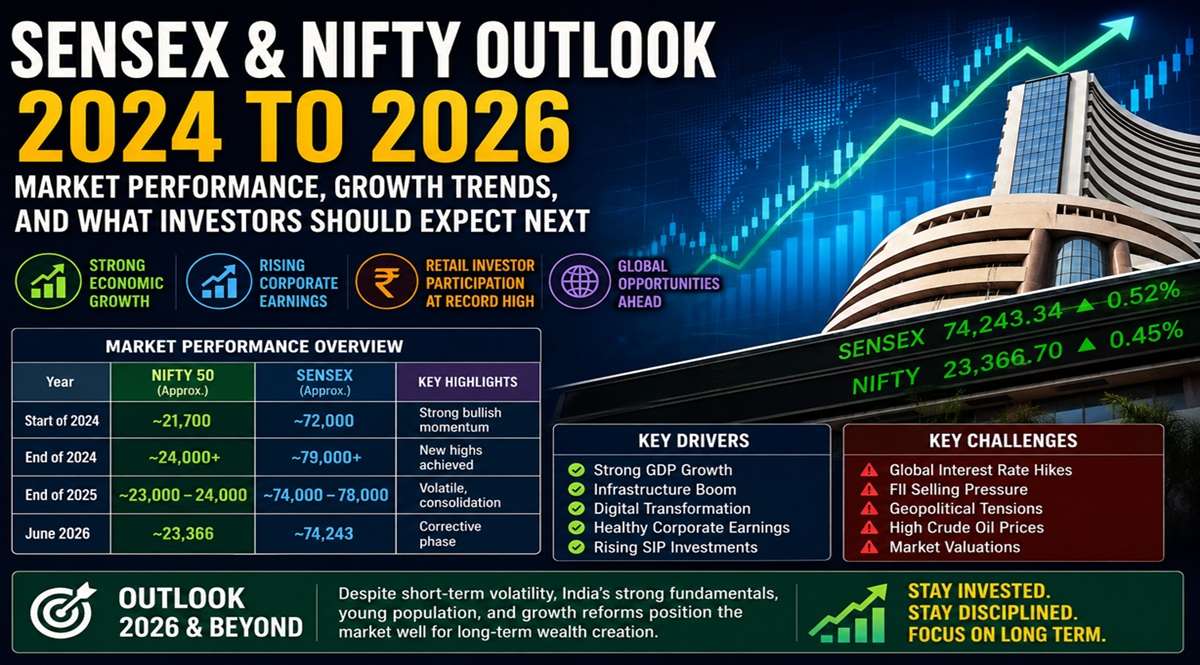
India’s Sensex (BSE-30) and Nifty 50 are up markedly since 2023 lows. The table below shows their year-end levels and annual returns:
| Year | Sensex End | Sensex Return | Nifty End | Nifty Return | Notes |
|---|---|---|---|---|---|
| 2023 (ref) | ~72,000 (Dec ’23) | — | ~21,800 | — | Starting base (approx) |
| 2024 | 78,139 | +8.18% | 23,658 | +8.76% | Midcap/smallcap led; peak levels (Sensex 85,978; Nifty 26,277). |
| 2025 | 85,221 | +9–10% (~) | 26,130 | +10.5% (~) | Both hit new highs (Sensex intraday 86,159). Cyclicals surged. |
| 2026 (YTD*) | ~74,243 | ~–12.9% | ~23,367 | ~–10.5% | Renewed volatility: crude/oil concerns & Fed expectations. |
Annual gains for 2025 are approximated from start/end values. YTD 2026 as of June 5. Note: Exact start-of-year values taken from end of prior year.
According to markets data and news reports, both indices enjoyed double-digit growth in 2024 and 2025, buoyed by robust earnings and domestic demand. For example, Sensex hit an all-time high of 86,159 on Dec 1, 2025. However, Q4 2024 and early 2026 saw corrections as global headwinds mounted.
Key Drivers and Events (2024–2026)
Monetary Policy (RBI and Fed)
- RBI Actions: After a long pause, India’s central bank shifted to easing in 2025. The RBI’s repo rate was held at 6.50% through 2024. Starting Feb 2025, the RBI cut rates cumulatively by 125 bps (25 bps in Feb, Apr, and Dec 2025; 50 bps in Jun 2025) to 5.25% by Dec 2025. The stance remained neutral. These cuts were prompted by easing inflation (which fell to ~2.0% mid-2025) and slowing growth. In June 2026, RBI again held rates at 5.25% and retained “neutral” stance, citing geopolitical and inflation uncertainties.
- US Fed Moves: The Federal Reserve’s policy steeply impacted global markets. By mid-2023, Fed funds rate reached 5.25–5.50% (highest since 2000). In late 2024–2025, the Fed began cutting rates amid cooling inflation. According to Forbes data, Fed cuts were -50 bps in Sep 2024, then -25 bps each in Nov and Dec 2024 (bringing target to 4.25–4.50%), followed by three 25 bps cuts in Sep, Oct, Dec 2025 (bringing to 3.50–3.75%). As of mid-2026, the Fed has signaled no immediate cuts but policymakers see cuts later (2027 base case). U.S. jobs reports also moved markets – for example, softer-than-expected US payrolls in May 2026 sent global equities higher, as it suggested Fed easing might come sooner.
Geopolitics & Oil
Middle East tensions and crude oil spikes weighed on sentiment. Since late 2023, clashes in West Asia raised fears of supply disruptions. Higher oil prices (> $80–90/barrel) stoke Indian inflation (India imports ~80% of oil) and widened India’s CAD, pressuring the rupee.
Domestic Factors
India’s macro data remained relatively strong. GDP growth stayed healthy (~6.5–7.5% YoY in FY25/26) due to resilient consumption and investment. However, high inflation in rural areas and RBI’s own slower GDP forecasts (6.6% for FY27) kept caution.
Elections in India (General Election 2024) proceeded smoothly, with continuity in policies reassuring investors.
Sectoral Trends (2024–25)
Equity market gains were not broad-based. In 2024, defensives like real estate, pharma, and healthcare soared (gains of ~33–41%), reflecting domestic demand resilience. Media and oil-marketing companies lagged. In 2025, cyclical sectors led the rally:
- Banking & Finance: PSU banks were the year’s top performer (+27.8% in 2025) on credit growth and stable asset quality. Private banks and NBFCs also gained. Financial Services index +16–17% (Banks +16.1%) YTD Dec 2025.
- Metals & Commodities: Nifty Metals +21.6% (2025 YTD) as global commodity prices firmed and infrastructure spending rose.
- Auto & Infra: Auto (+21.1%) and Infrastructure (+12.9%) indices did well on strong demand. Auto demand held up due to replacement cycles (cars/trucks).
- IT & Tech: IT stocks were mixed. Many fell in 2025 due to USD strength and global slowdown fears, but lower valuations and AI hype kept them on watchlists (TCS/Infosys among top caps).
- Consumption/Defensives: Consumer staples and FMCG (+7–9%) were stable but lagged cyclical sectors. Mid/small caps outperformed in 2024 (Nifty Midcap/Smallcap +20%+) as investors hunted growth.
Overall, high-beta sectors (banking, auto, metals) led markets, while low-beta (MNCs, consumption) delivered modest single-digit gains.
FII/DII Flows and Market Sentiment
Foreign institutional investors (FIIs) have become net sellers in recent times. FPI net outflows reached ~₹1.7 lakh crore in 2025 and surged to ~₹2.3 lakh crore in Jan–May 2026. This exceptional selling (especially Mar–May 2026) reflected global fund rotations and higher US yields. For context, March 2026 saw ₹1.17 lakh cr outflow alone. Sell-offs intensified with each spike in U.S. yields or oil prices.
Domestic institutions (DIIs) and retail mutual funds largely offset FII selling. Mutual fund SIP inflows reached record highs (₹20,000+ cr/month by 2025), and DIIs parked over ₹82,600 cr in equities in May 2026. In short, while FIIs pulled money out, DIIs provided a countervailing “floor” through relentless buying, aiding market stability.
Valuation and Technical Levels
As of mid-2026, India’s valuations are moderate. Sensex’s P/E (trailing) hovers around 20–21x, near long-term average. By comparison, it had peaked at ~36x in Feb 2021. Price-to-Book (P/B) is roughly 3–4x for large caps. These metrics imply markets are not cheap, but not wildly expensive given still-solid earnings growth.
Key Index Levels (June 2026): Analysts note Nifty 50 has near-term support ~23,150–23,250 and resistance ~23,500–23,800. Sensex support is ~73,800–74,000; resistance ~74,800–75,500. A decisive break below support zones could trigger further selling (as cautioned by experts). On the upside, a rally above 24,000 (Nifty) and 76,000 (Sensex) would negate the downtrend.
Risks to Outlook
- Global Rates & Fed: A faster-than-expected Fed tightening cycle or surprises in US inflation could keep global rates high longer, reducing FII flows into equities.
- Geopolitics & Oil: Escalation of Middle East conflicts could spike oil prices above $100/bbl, stoking Indian inflation and hurting consumption. Currency pressure from oil may force RBI to lean more hawkish.
- Domestic Growth Slowdown: A slowdown in India’s GDP/GVA (e.g. due to monsoon shortfall or weak rural demand) would dampen earnings.
- Valuation Shock: Stocks run up ahead of fundamentals could face sharp corrections if earnings disappoint.
- Global Tech Downturn: A renewed selloff in US tech could spill over to Indian tech indices.
Conversely, positive surprises like faster-than-expected disinflation (prompting a rate cut) or strong corporate results could spark rallies.
Investment Strategy and Tips
- Stay Invested via SIP: Periods of weakness can be opportunity. Continuing systematic investments (SIPs) helps average costs and benefit from long-term growth (India’s consumption and digital economy). Despite volatility, India’s fundamentals (young demographics, consumption growth) remain intact.
- Quality Over Speculation: Focus on established, profitable companies with strong balance sheets. Sectors like banking, IT, select industrials, and consumer staples often weather cycles better. Avoid chasing momentum in uncertain times.
- Diversify: Balance between large-caps (core portfolio) and some mid-caps or thematic bets (auto, pharma, infrastructure) if risk appetite allows. ETFs and index funds can help diversification at low cost.
- Risk Management: Limit leverage and be prepared to book partial gains on euphoria. Consider a “sell-on-rise” approach in the near term (as some strategists suggest), keeping enough liquidity to buy dips.
- Long-Term View: Over 3–5 years, many analysts remain optimistic that India’s growth story can take Sensex higher (Morgan Stanley, for example, sees Sensex ~100,000 by 2026). But short-term, be ready for swings.
Executive Summary
- 2024 Performance: Sensex ended 2024 at ~78,139 (+8.18%) and Nifty at ~23,658 (+8.76%), marking India’s ninth straight year of gains. Midcaps and smallcaps outperformed, with sectoral winners like real estate (+41%), pharma (+35%), healthcare (+33%). Weakness appeared late 2024 as FIIs sold aggressively.
- 2025 Performance: Sensex closed 2025 around 85,221 and Nifty at 26,130, each up ~10% for the year. Key sectors rallying in 2025 included PSU banks (+28%), metals (+21.6%), and autos (+21.1%), while defensive names lagged. Both indices hit record highs (Sensex intraday 86,159; Nifty 26,600+).
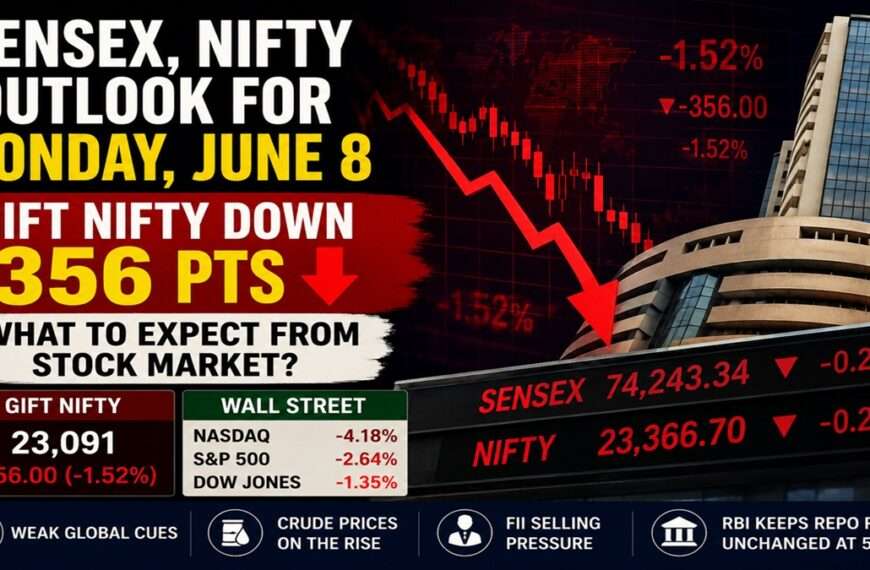
- YTD 2026: As of June 2026, Sensex (~74,240) and Nifty (~23,367) are below their year-start levels, off ~10–13% YTD. Markets have been correcting amid Fed rate-hike carryover and global headwinds. A US jobs report in May 2026 hinted at a cooling labor market, offering hopes of sooner Fed easing.
- Macro/Policy Events: RBI held policy steady in 2024-early-25 (repo 6.5%), then cut rates by 125 bps through Dec 2025 to 5.25%. The Fed raised rates through 2022-23 (peaking ~5.25–5.5%), then began cutting by Sep 2024, totaling 100 bps in 2024 and 75 bps in 2025. Geopolitical risks (Middle East tensions, US elections) and oil price spikes also swayed markets.
- Flows: Foreign funds sold heavily in 2026; FIIs pulled ~₹2.3 lakh cr from equity markets in Jan–May 2026, exceeding all of 2025 outflows. In contrast, domestic investors (DIIs) remained net buyers (May 2026 DII inflows ~₹82,600 cr), providing support.
- Valuations & Risks: India’s valuations (Sensex P/E ~20–21 in mid-2026) are around long-term norms (far below the 36x peak of 2021). Key risks include rising global rates, stagflation, geopolitics (oil-price shocks), and currency volatility.
- Investor Strategy: Maintain SIP discipline and focus on quality growth stocks. Sector picks include financials (banking, NBFCs), technology, and domestic consumer names. Cautious traders may “sell on rallies” until clear market leadership emerges. Risk management—moderate leverage and diversified portfolios—is advised in light of external uncertainties.
Figure: Stock market chart displaying Sensex/Nifty price trends and recent volatility.
Frequently Asked Questions (FAQs)
What were Sensex and Nifty returns in 2024?
Sensex gained ~8.2% in calendar 2024, closing around 78,139 on Dec 31, 2024. Nifty rose ~8.8% to close ~23,658.
How did Sensex and Nifty perform in 2025?
In 2025, both indices were up roughly 10% for the year. Sensex ended near 85,221 and Nifty near 26,130, each crossing record highs during the year.
What’s the YTD 2026 market trend?
As of June 2026, Sensex and Nifty are below their Jan 2026 levels, down around 10–13% YTD. Markets have been correcting amid global rate concerns and oil price spikes.
Which sectors led market gains recently?
Cyclicals dominated. In 2025, PSU banks (+27.8%), metals (+21.6%), autos (+21.1%) and finance (+16%+) were top performers. Pharma, real estate, and healthcare were strong in 2024 (gains 33–41%).
Why are markets correcting in 2026?
Factors include higher-than-expected inflation globally, stubborn US rates, geopolitical tensions (driving oil up), and FII outflows. Domestic inflation in India also pressured sentiment.
What are Sensex/Nifty key support and resistance levels?
Analysts cite Nifty support ~23,150–23,250 and immediate resistance ~23,500–23,800. Sensex support ~73,800–74,000 and resistance ~74,800–75,500.
What is the RBI’s current policy stance?
RBI’s repo rate is 5.25% (as of mid-2026) with a neutral stance. After holding through 2024, RBI cut rates in 2025 totaling -125 bps, then paused. Inflation is moderating (~4% by early 2026), allowing flexibility.
What is the Fed doing and how does it affect India?
The Fed has paused after aggressive hikes. It cut rates late 2024/25 (now 3.5–3.75%) and hinted on hold in 2026. U.S. rate decisions matter for India: higher U.S. rates pull FIIs away, while cuts or dovish signals usually spur FII inflows.
What valuation are Indian markets at?
Sensex’s P/E is around 20–21x (as of mid-2026) on trailing earnings. This is near historical average and well below peaks (~36x in early-2021). P/B ratios for large caps are roughly 3–4x.
Is Sensex likely to hit 100,000 soon?
Some forecasts (e.g. Morgan Stanley) see Sensex 100,000 by late 2026 under a strong bull scenario. However, current consensus is more cautious given global uncertainty. It’s a long-term possibility if India’s growth remains strong.
What investment strategy should one follow now?
Continue disciplined SIP investing across quality stocks or diversified funds. Focus on sectors with solid earnings (banks, IT, pharma, consumer). Manage risks by avoiding concentrated bets and maintain some cash for buying on dips.
How important is SIP with current volatility?
SIPs can reduce timing risk and capture market’s long-term rise. Indian SIP inflows have been record-high, reflecting investor confidence even during bouts of volatility.
What role do DIIs play?
Domestic Institutional Investors (mutual funds, insurance) have been consistent buyers, helping stabilize markets when FIIs exit. In May 2026, DIIs pumped ~₹82,600 cr into equities.
How do global events impact Indian markets?
Heavily. U.S. Fed policy (rates/quantitative) directly influences flows. Global growth scares or crashes (e.g. recession fears) typically drag Indian equities. Conversely, foreign capital often rushes into India when global yields fall or risk appetite rises.
Is the current dip a buying opportunity?
Many analysts see a dip as an opportunity for long-term investors, citing India’s strong GDP growth and consumption story. However, timing the bottom is hard. It’s sensible to allocate gradually and focus on fundamentals.
Disclaimer:
This article is for informational purposes only and does not constitute investment advice. Investors should conduct their own research or consult a financial advisor before making investment decisions. Past performance is not indicative of future results.