

Introduction
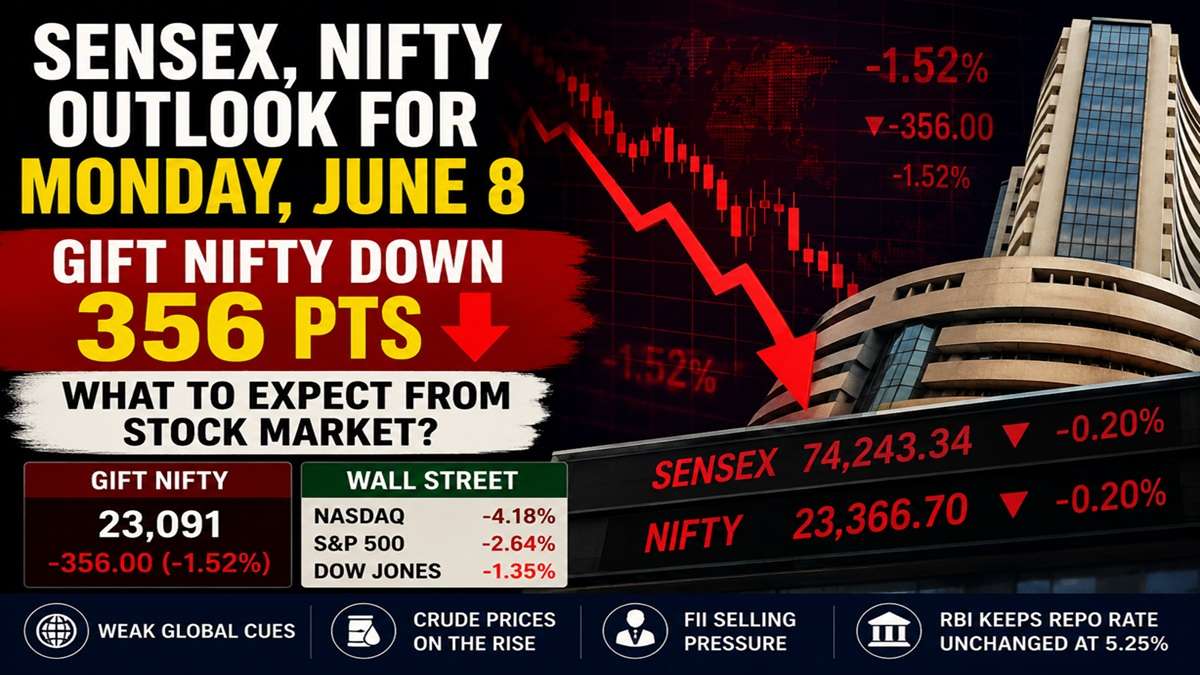
Indian stock markets are expected to begin the week on a weak note as GIFT Nifty plunged 356 points, indicating a sharp gap-down opening on Monday, June 8. The bearish sentiment comes after a major sell-off in U.S. markets, concerns over global interest rates, geopolitical tensions in West Asia, and continued foreign investor selling.
Both the BSE Sensex and NSE Nifty ended lower for the second consecutive week, reflecting growing caution among investors amid global uncertainties.
Market Performance Last Week
Domestic equity markets closed in the red for the second straight week.
- BSE Sensex closed at 74,243.34
- NSE Nifty settled at 23,366.70
- Both indices declined approximately 0.7% during the week
- Friday’s session ended with a loss of around 0.2%
The overall market sentiment remained weak as investors reacted to global economic developments and foreign fund outflows.
GIFT Nifty Signals Gap-Down Opening
GIFT Nifty futures on the NSE International Exchange dropped 356 points, or 1.52%, to 23,091. This sharp decline suggests that Indian markets may open significantly lower on Monday.
A gap-down opening generally indicates that traders expect negative sentiment to continue from global markets into domestic trading sessions.
Wall Street Sell-Off Triggers Global Concerns
The weakness in Indian markets follows a major overnight correction in U.S. equities.
Key U.S. Market Performance
- Nasdaq Composite fell 4.18% to 25,709.43
- S&P 500 declined 2.64% to 7,383.74
- Dow Jones Industrial Average dropped 1.35% to 50,866.78
The technology-heavy Nasdaq recorded its worst single-day performance in more than a year as AI and technology stocks faced heavy selling pressure.
Why Did Global Markets Fall?
Strong U.S. Jobs Data
A stronger-than-expected U.S. jobs report raised concerns that the Federal Reserve may keep interest rates higher for a longer period.
Higher interest rates generally reduce liquidity in financial markets and make equities less attractive compared to fixed-income investments.
Geopolitical Tensions
Rising tensions in West Asia continue to impact investor sentiment. Market participants are closely monitoring developments that could influence crude oil prices and global economic stability.
Foreign Investor Selling
Foreign Institutional Investors (FIIs) remained aggressive sellers during the first week of the month.
- FII Net Outflow: ₹31,114.47 crore
- DII Net Inflow: ₹33,933.05 crore
While domestic institutional investors provided support, foreign selling pressure continues to weigh on the market.
RBI Monetary Policy Impact
The Reserve Bank of India (RBI) maintained the repo rate at 5.25% and kept its policy stance neutral.
Although the decision was largely expected, investors remain focused on future economic growth prospects and inflation trends.
Key Nifty Levels to Watch
Support Levels
- Immediate Support: 23,250 – 23,150
- Strong Support: 23,000
- Major Downside Target: 22,800
Analysts believe that a decisive break below 23,150 could trigger additional selling pressure.
Resistance Levels
- Immediate Resistance: 23,500 – 23,550
- Recovery Zone: 23,750 – 23,800
- Major Resistance: 24,000
Experts suggest maintaining a sell-on-rise strategy until Nifty manages to reclaim and sustain above 23,700.
Key Sensex Levels to Watch
Support
- 74,000 – 73,800
Resistance
- 74,600 – 74,800
- Higher Resistance: 75,500 – 75,800
These levels are expected to guide short-term market direction.
Investment Strategy for Investors
Market experts recommend a cautious and selective approach.
Key Suggestions
- Focus on fundamentally strong companies.
- Prefer businesses with healthy balance sheets.
- Invest in sectors benefiting from domestic demand.
- Avoid excessive leverage during volatile conditions.
- Maintain proper risk management practices.
With the earnings season largely behind, markets may remain range-bound until investors gain greater clarity on global economic conditions and domestic growth trends.
Conclusion
Indian markets are likely to face a challenging start on Monday as weak global cues, rising geopolitical concerns, and foreign investor selling continue to pressure sentiment. GIFT Nifty’s sharp decline indicates a gap-down opening, while key support levels on Nifty and Sensex will be closely monitored by traders.
Long-term investors should remain focused on quality businesses and avoid making decisions based solely on short-term market volatility.
Disclaimer:
The information provided in this article is for educational and informational purposes only and should not be considered financial, investment, or trading advice. Stock market investments are subject to market risks, and past performance does not guarantee future results. Readers are advised to conduct their own research and consult a qualified financial advisor before making any investment decisions. The author and publisher shall not be held responsible for any financial losses arising from the use of the information provided in this article.
Frequently Asked Questions (FAQs)
Why is GIFT Nifty down today?
GIFT Nifty is trading lower due to weak global market sentiment, a sharp sell-off in U.S. markets, concerns over higher interest rates, and ongoing geopolitical tensions in West Asia.
What does a gap-down opening mean in the stock market?
A gap-down opening occurs when the market opens significantly lower than the previous day’s closing price, usually due to negative news or weak global market cues.
What are the key support levels for Nifty?
According to market analysts, the immediate support zone for Nifty is between 23,250 and 23,150. A break below this range could lead to further downside toward 23,000 or even 22,800.
What are the important resistance levels for Nifty?
The immediate resistance zone lies between 23,500 and 23,550. A strong breakout above these levels could push Nifty toward 23,750–23,800 and eventually 24,000.
Why are global markets affecting Indian stock markets?
Indian markets are connected to global financial markets. Major movements in U.S. markets, interest rate decisions, geopolitical developments, and foreign investment flows often influence investor sentiment in India.
How did Foreign Institutional Investors (FIIs) impact the market?
FIIs remained net sellers during the first week of the month, leading to increased market pressure. Heavy foreign outflows can negatively affect stock prices and overall market sentiment.
What is the RBI repo rate and why is it important?
The repo rate is the rate at which the Reserve Bank of India lends money to commercial banks. It influences borrowing costs, economic growth, and stock market sentiment.
Is this a good time to start a SIP?
Many financial experts believe that continuing or starting a SIP during market corrections can help investors benefit from rupee cost averaging and long-term wealth creation.
Table of Contents

Sensex & Nifty Outlook 2024–2026: Annual Returns, Key Events & Investing Guide
India’s benchmark indices have shown resilience from 2024 through mid-2026,…

Vedanta Demerger 2026: 5 Company Split by Anil Agarwal – Stock Double Potential?
Vedanta is set to split into 5 companies, and experts…

Indian IT Stocks Fall for 5th Straight Session: Is AI the Real Threat?
Indian IT stocks continued their losing streak for the fifth…

India–US Trade Deal Slashes Tariffs to 18%: Why Indian Exporters Now Have a Global Edge
India has emerged stronger in global trade after the US…

Big Relief for India: US Slashes Tariffs to 18% After Modi–Trump Talks
After nearly a year of strained relations and record-high tariffs,…