
Introduction
Every year, millions of people enter the stock market with hope, excitement, and dreams of financial freedom. They see news headlines about record highs, friends talking about profits, and social media posts showing quick gains. Yet, despite this enthusiasm, most retail investors end up losing money.
This creates a common question:
“If the stock market creates wealth, why do so many people lose money in it?”
The answer is simple but uncomfortable — the stock market is not the problem; human behavior is.
The stock market rewards patience, discipline, and understanding. It punishes impatience, greed, fear, and shortcuts. People who treat the market like a casino usually lose. Those who treat it like a long-term wealth-building tool usually win.
1. Lack of Basic Financial Knowledge
The biggest reason people lose money is entering the market without understanding how it works.
Most beginners don’t know:
- What a stock actually represents
- How companies earn profits
- How market cycles work
- The difference between price and value
Instead, they rely on:
- WhatsApp tips
- Telegram channels
- YouTube “sure shot” calls
- Friends’ recommendations
Real-Life Example
Ramesh, a salaried employee, bought a stock because his office colleague said,
“This stock will double in six months.”
Ramesh didn’t know:
- What the company does
- Whether it was profitable
- Why the stock price was rising
When the stock fell 30%, he panicked and sold at a loss.
📌 Lesson:
If you don’t understand what you own, you will never have confidence during market volatility.
2. Unrealistic Expectations & Get-Rich-Quick Mentality
Many people enter the stock market with wrong expectations.
They believe:
- Stock market = quick money
- Daily profits are normal
- Losses shouldn’t happen
- Returns should be guaranteed
This mindset comes from:
- Social media hype
- Fake success stories
- Influencers showing only profits
Reality Check
The stock market is not a lottery, and it is not fixed income.
- Short-term movements are unpredictable
- Losses are part of the journey
- Wealth is built slowly, not overnight
📌 Truth:
If you expect fast money, the market will teach you expensive lessons.
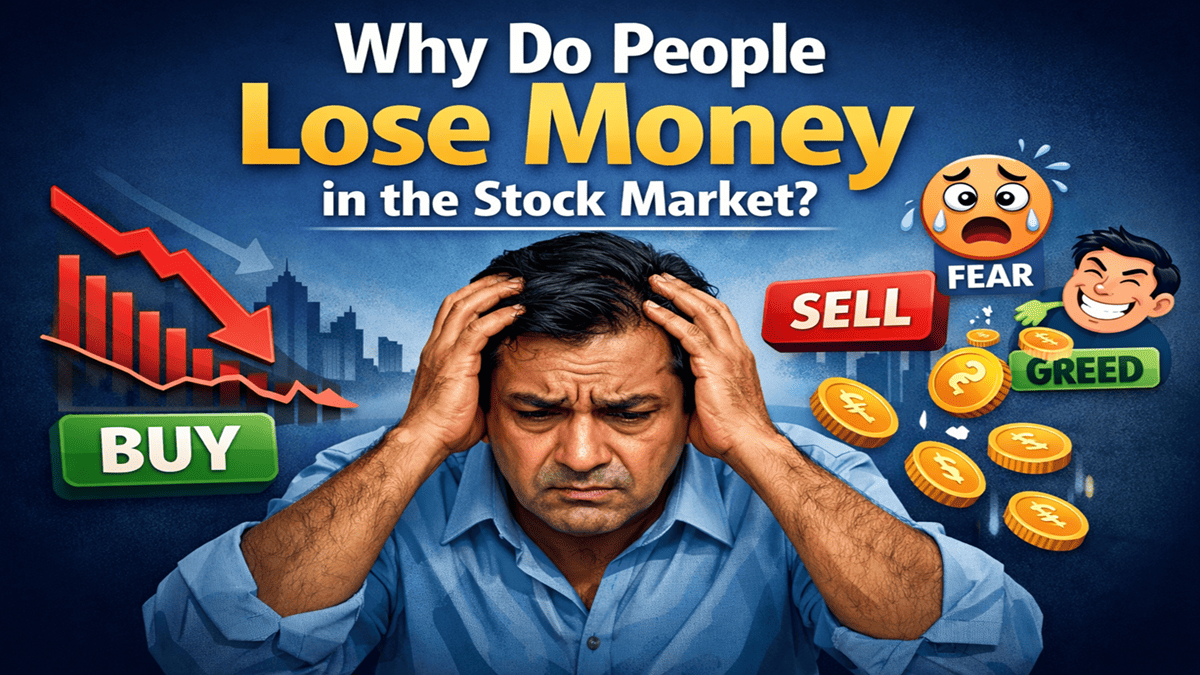
3. Emotional Investing: Fear and Greed
The stock market is more about psychology than intelligence.
Two emotions destroy investors:
🔴 Greed
Greed makes people:
- Buy when prices are already high
- Invest more after seeing quick profits
- Chase trending stocks
They think:
“Everyone is making money. I will miss out if I don’t buy now.”
🔵 Fear
Fear makes people:
- Panic during market corrections
- Sell during crashes
- Exit at the worst possible time
They think:
“What if I lose everything?”
📌 Irony:
People buy when markets are expensive and sell when markets are cheap.
4. No Clear Investment Plan
Many investors have no plan, no structure, and no clarity.
They don’t know:
- Why they are investing
- For how long they will stay invested
- What level of risk they can handle
Without a plan:
- Every market fall creates confusion
- Every rise creates greed
- Decisions become emotional
📌 A bad plan is better than no plan.
5. Treating the Stock Market Like Gambling
Some people treat trading like betting:
- All money in one stock
- All money in one trade
- No risk management
They believe:
“One big trade will change my life.”
📌 Result:
One wrong move can wipe out years of savings.
The stock market is not gambling, but careless behavior turns it into one.

6. Overtrading & Excessive Activity
Many people believe:
“The more I trade, the more I will earn.”
This is a myth.
Overtrading leads to:
- High brokerage charges
- Poor decision-making
- Emotional exhaustion
- Inconsistent results
📌 Fact:
Most successful investors trade less, not more.
7. Lack of Diversification
Putting all money into:
- One stock
- One sector
- One theme
is extremely risky.
If that investment fails, the entire portfolio suffers.
Example
An investor puts all money into a single IT stock.
If the IT sector faces a downturn, the entire portfolio falls.
📌 Diversification is not for returns; it is for survival.
8. Ignoring Risk Completely
Most people talk only about:
- Returns
- Profits
- Upside
They ignore:
- Downside risk
- Volatility
- Worst-case scenarios
When losses happen, they panic because they were never mentally prepared.
📌 Risk is not the enemy; ignorance of risk is.
9. Copying Others Blindly
Many people invest based on:
- Friend’s portfolio
- Social media posts
- Influencer recommendations
They forget:
- Risk appetite is different
- Capital size is different
- Time horizon is different
📌 What works for others may not work for you.
10. Poor Timing & Market Chasing
People often:
- Enter after markets have already risen
- Exit after markets have already fallen
They chase performance instead of process.
📌 Smart investors follow discipline, not trends.
11. No Patience for Compounding
Compounding needs:
- Time
- Discipline
- Consistency
Many people:
- Exit too early
- Judge results in months
- Lose patience during volatility
📌 The biggest returns come in the last few years, not the first few.
12. Lack of Discipline & Consistency
Successful investors:
- Invest regularly
- Stay invested during falls
- Follow rules
Unsuccessful investors:
- Stop investing during downturns
- Restart when markets rise
- Keep changing strategies
📌 Consistency beats intelligence in the stock market.
13. Confusing Trading with Investing
Trading and investing are different:
- Trading needs skill, time, experience
- Investing needs patience and discipline
Many beginners trade without understanding and lose money quickly.
📌 Most people should invest, not trade.
14. No Review, No Learning
People repeat the same mistakes because they:
- Never review losses
- Never analyze decisions
- Never improve strategies
📌 Losses are lessons only if you learn from them.
How to Avoid Losing Money in the Stock Market
- Learn basic concepts
- Invest with clear goals
- Control emotions
- Prefer SIPs
- Diversify portfolio
- Focus on long-term wealth
- Avoid hype and shortcuts
Final Thoughts: The Market Is Fair, Not Easy
The stock market does not discriminate.
It rewards discipline and punishes impatience.
Disclaimer
The information provided on this website is for educational and informational purposes only and should not be considered as financial, investment, or legal advice.
Stock market investments are subject to market risks, including the possible loss of capital. Past performance is not a guarantee of future returns. Market conditions can change at any time.
Readers are advised to:
- Do their own research before making any investment decisions
- Carefully assess their risk tolerance and financial goals
- Consult a SEBI-registered financial advisor if required
TrendingAdda.in does not make any guarantees regarding the accuracy, completeness, or reliability of the information provided and shall not be responsible for any financial losses incurred.
Why do most beginners lose money in the stock market?
Most beginners lose money because they invest without proper knowledge, follow tips blindly, and make emotional decisions driven by fear and greed.
Is the stock market risky or are people making mistakes?
The stock market itself is not risky; wrong decisions, lack of discipline, and unrealistic expectations are the real reasons people lose money.
Can common people really make money in the stock market?
Yes, common investors can make money if they focus on long-term investing, SIPs, diversification, and patience instead of quick profits.
Why do people panic sell during market crashes?
People panic sell due to fear, lack of confidence, and not understanding that market corrections are temporary and normal.
Is trading the main reason people lose money?
Yes, frequent trading without experience, strategy, and risk management is one of the biggest reasons retail investors lose money.
How long should I stay invested to avoid losses?
A minimum investment horizon of 5–10 years helps reduce volatility and allows compounding to work effectively.
Do SIP investors also lose money?
SIP investors usually face short-term fluctuations, but long-term SIP investors rarely lose money if they stay disciplined.
Can emotions really destroy stock market returns?
Absolutely. Fear, greed, overconfidence, and impatience are among the biggest wealth destroyers in the stock market.
What is the biggest mistake investors make?
The biggest mistake is expecting quick profits instead of focusing on learning, consistency, and long-term wealth creation.
How can I stop losing money in the stock market?
Start by learning basics, investing regularly, avoiding tips, diversifying your portfolio, and controlling emotions.