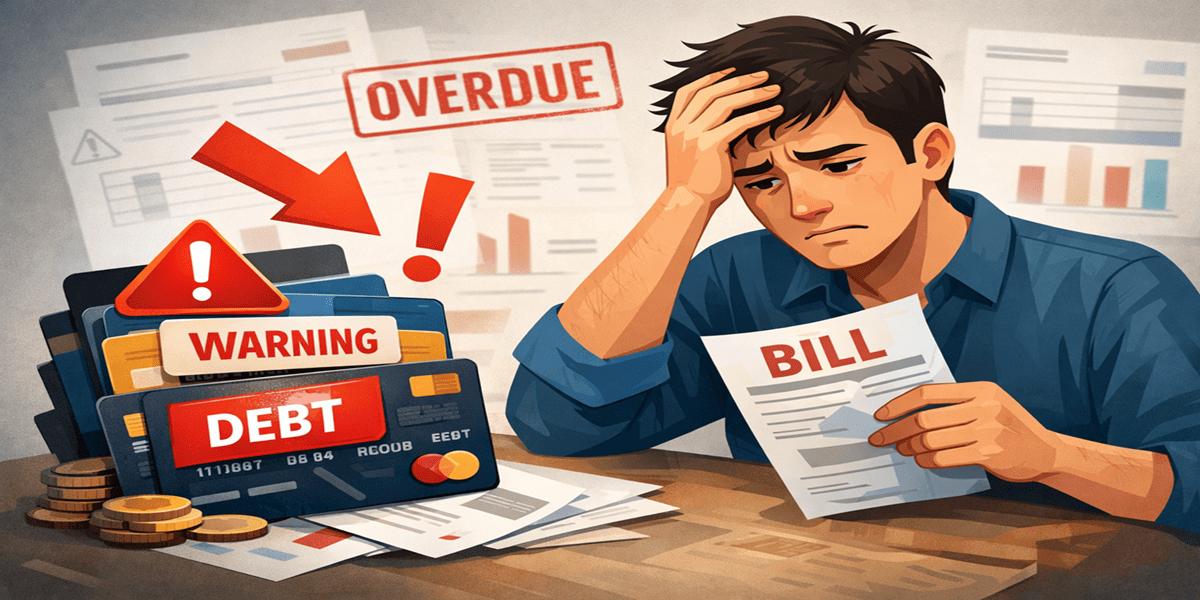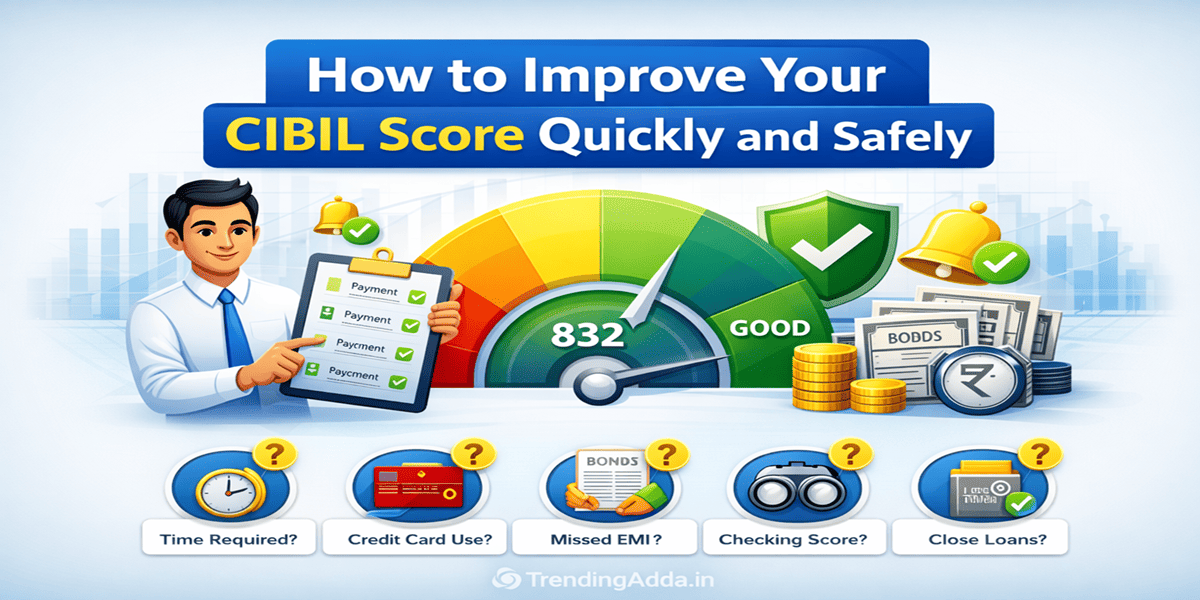
Most people start caring about their CIBIL score only when something goes wrong — a loan gets rejected, a credit card application fails, or the bank suddenly offers a much higher interest rate than expected.
I’ve seen this happen countless times. A friend earning well couldn’t get a bike loan approved. Another colleague was shocked when a home loan was delayed because of a “low credit score” — something he never even checked before.
The good news?
A CIBIL score is not permanent damage.
The bad news?
Trying to “fix it quickly” using shortcuts often makes things worse.
This guide explains how to improve your CIBIL score quickly and safely, without myths, agents, or risky tricks.
What Is a CIBIL Score (In Simple Terms)
Your CIBIL score is a 3-digit number ranging from 300 to 900.
Banks and NBFCs use it to judge how trustworthy you are as a borrower.
- 750+ → Excellent
- 700–749 → Good
- 650–699 → Average
- Below 650 → Risky borrower
It’s not about income alone.
It’s about behavior — how you use credit.
You could earn ₹20,000 or ₹2,00,000 per month. If you misuse credit, the score will suffer.
Real-Life Example: How Scores Get Damaged Quietly
Let me share a very common story.
Rohit (name changed) took a credit card at 23.
Limit: ₹50,000.
At first, he used it carefully. Then came online sales, food apps, and “buy now pay later” offers.
One month, he paid only the minimum due.
Another month, he missed the payment date by 10 days.
He thought:
“It was only 10 days late — will it really make a difference?”
That single delay dropped his CIBIL score by 60+ points.
No warning. No SMS explaining damage.
Just a silent hit.
That’s how CIBIL works.
Why Your CIBIL Score Falls (The Real Reasons)
Forget complicated theories.
In real life, CIBIL scores fall because of these reasons only:
1. Missed or Late EMIs
Even one missed EMI stays on your report for years.
Home loan, personal loan, bike loan — all count.
2. Credit Card Overuse
Using 80–90% of your limit regularly signals stress.
₹45,000 used out of ₹50,000 limit = red flag.
3. Too Many Loan Enquiries
Applying everywhere = desperation in bank records.
4. Settled Loans (Not Closed)
“Settlement” sounds nice, but it damages trust badly.
5. No Credit History at All
Yes, zero credit can also be a problem.
Step 1: Check Your CIBIL Report (Don’t Skip This)
Before fixing anything, know the problem.
Get your free CIBIL report from:
- CIBIL official site
- Bank apps
- Paisabazaar, Wishfin, etc.
Look for:
- Late payment remarks
- Wrong loan entries
- Closed loans still showing active
- Unknown credit cards or loans
Many people improve their score simply by correcting errors.
Step 2: Fix EMI Discipline (This Matters the Most)
If you do just ONE thing right, make it this.
Set Auto-Debit for EMIs
Manual payments fail because life happens:
- Salary delay
- Travel
- Forgetfulness
Auto-debit removes emotion from the process.
Example:
Aman missed 2 bike EMIs in 2022.
He set auto-debit in 2023.
Within 9 months of perfect payments, his score improved from 642 to 712.
No magic. Just consistency.
Step 3: Use Credit Cards Like a Tool, Not Free Money
Credit cards don’t destroy scores.
Misuse does.
Golden Rule:
Use less than 30% of your credit limit.
If your limit is ₹1,00,000:
- Ideal usage: ₹20,000–₹30,000
- ₹70,000–₹90,000 every month = score killer
Real-Life Observation:
People who pay full amount on time but always use 80% limit still struggle with scores.
Why?
Because CIBIL tracks utilization, not just payment.
Step 4: Never Pay Only the Minimum Due
This is the most misunderstood trap.
Minimum due:
- Saves you from late fees
- Does NOT save your CIBIL score
It shows financial stress.
If you can’t pay full:
- Reduce spending next month
- Convert to EMI (carefully)
- But don’t make minimum due a habit
Step 5: Stop Applying for Too Many Loans
Every loan or credit card application creates a hard enquiry.
Too many enquiries within 3–6 months = panic signal.
Example:
Ravi applied for:
- 2 credit cards
- 1 personal loan
- 1 BNPL app
All within 30 days.
Result:
Score dropped by 35 points, even before approval.
Apply only when necessary.


Step 6: Old Loans Are Not Your Enemy
Many people close old credit cards thinking:
“Purana card band kar deta hoon.”
Bad idea.
Old accounts show:
- Long credit history
- Stability
- Trust
Unless a card has heavy fees, keep it active with small usage.
Step 7: Avoid Loan Settlements If Possible
Settlement = partial payment.
Banks mark it as:
“Borrower did not repay fully.”
This hurts badly.
If stuck:
- Try restructuring
- Extend tenure
- Negotiate interest
- Ask for moratorium
Settlement should be the last option, not first.
Step 8: How Long Does Improvement Really Take?
Let’s be realistic.
| Action | Impact Time |
|---|---|
| Correct report errors | 30–45 days |
| Regular EMI payments | 3–6 months |
| Credit utilization improvement | 1–2 months |
| Major recovery (bad history) | 9–18 months |
Anyone promising “30-day guaranteed fix” is lying.
Can You Improve CIBIL Score Quickly?
“Quickly” doesn’t mean overnight.
It means:
- Avoiding further damage
- Showing good behavior consistently
- Letting time work for you
The fastest safe improvements come from:
- Paying dues on time
- Reducing card usage
- Stopping unnecessary applications
Common Myths You Should Ignore
- ❌ “Paying agents can remove late payments”
- ❌ “Closing all loans improves score”
- ❌ “Checking CIBIL lowers score”
- ❌ “Income increase automatically raises score”
Only behavior matters.
One Honest Opinion (From Experience)
Your CIBIL score is like your reputation.
You don’t rebuild trust by saying sorry once.
You rebuild it by showing up on time again and again.
Banks don’t want perfection.
They want predictability.
Final Thoughts: Build It Once, Protect It Always
Improving your CIBIL score is not about tricks.
It’s about habits.
Once your score improves:
- Don’t celebrate and forget
- Keep monitoring every 3–6 months
- Treat credit with respect
Because one careless month can undo years of effort.
Professional Disclaimer
This article is for educational purposes only. It does not constitute financial or legal advice. Credit policies may vary across banks and NBFCs. Always consult a qualified financial advisor or lender before making credit-related decisions.
Frequently Asked Questions (FAQ)
1. How can I improve my CIBIL score fast without taking risks?
The safest way to improve your CIBIL score quickly is by paying all EMIs and credit card bills on time, reducing credit card usage below 30%, and avoiding new loan applications. There are no shortcuts that work without risk.
2. How much time does it really take to increase a CIBIL score?
Small improvements can be seen within 30–60 days, but meaningful recovery usually takes 3–6 months of disciplined credit behavior. If there are major past defaults, it may take up to a year or more.
3. Does paying with credit card minimum due improve CIBIL score?
No. Paying only the minimum due avoids late fees but does not help your CIBIL score. It actually signals financial stress and can negatively impact your credit profile over time.
4. Can a single missed EMI reduce my CIBIL score?
Yes. Even one missed EMI can reduce your CIBIL score by 30–70 points depending on your credit history and loan type. Late payments are one of the biggest negative factors.
5. Is it true that checking CIBIL score lowers the score?
No. Checking your own CIBIL score is a soft enquiry and does not affect your score at all. You can check it multiple times safely.
6. Should I close old loans or credit cards to improve my score?
Not always. Old credit accounts help build a longer credit history. Closing them can sometimes reduce your score, especially if they have a good repayment record.
7. Can loan settlement improve my CIBIL score?
Loan settlement usually damages your credit score. It shows that the loan was not fully repaid. Closing the loan after full payment is always better than settlement.
8. How much credit card usage is considered safe?
Ideally, you should use less than 30% of your total credit limit. For example, if your card limit is ₹1,00,000, try to keep usage under ₹30,000.
9. Does income increase improve CIBIL score?
No. Your salary or income level does not directly affect your CIBIL score. Only your credit usage and repayment behavior matter.
10. Can a low CIBIL score be fixed permanently?
Yes. With consistent on-time payments, controlled credit usage, and patience, even a low CIBIL score can be rebuilt permanently over time.