
Introduction
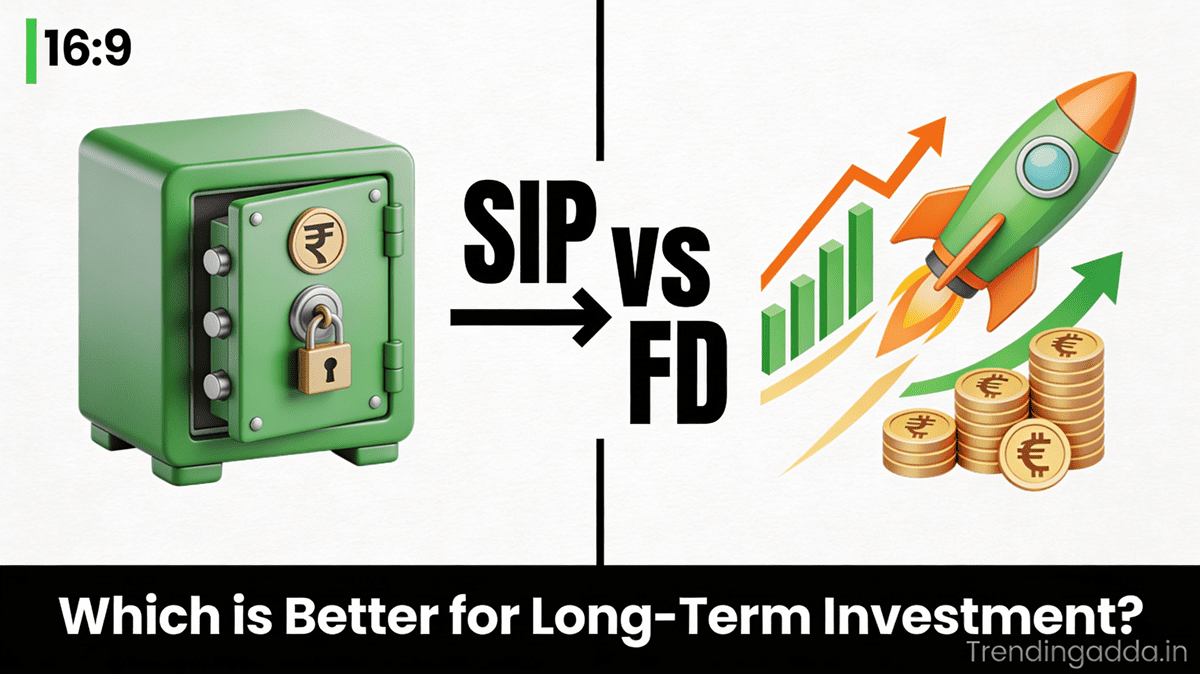
When Indians think about saving or investing money, two options usually come first: SIP (Systematic Investment Plan) and FD (Fixed Deposit). Both are popular, trusted, and widely used. However, they work very differently and serve different financial goals.
Many people invest in SIP vs FD without fully understanding:
- How these instruments actually work
- What kind of returns to expect
- The risks involved
- Which option suits long-term or short-term goals
This blog explains how SIP and FD work, supported by real-life Indian case studies, simple tables, and practical examples so that readers can make informed decisions without confusion.
What Is SIP and How Does It Work?
What Is SIP?
SIP (Systematic Investment Plan) is a method of investing a fixed amount regularly (usually monthly) into a mutual fund. SIP itself is not an investment product; it is a way to invest in mutual funds.
Through SIP, money is invested automatically at regular intervals, regardless of market conditions.
How SIP Works
- Choose a Mutual Fund
- Equity funds
- Index funds
- Hybrid funds
- Decide Monthly Amount
- Minimum can be as low as ₹500
- Auto-Debit from Bank
- Amount is deducted every month automatically
- Units Are Allotted
- Based on market NAV (price per unit)
- Compounding Over Time
- Returns grow over long periods
Why SIP Is Powerful
- Uses rupee cost averaging
- Reduces impact of market volatility
- Encourages discipline
- Suitable for long-term wealth creation
SIP Case Study (Realistic Indian Example)
Case Study: Rahul – Salaried Middle-Class Professional
Profile
- Age: 28 years
- Monthly Income: ₹40,000
- Monthly SIP Investment: ₹5,000
- Investment Type: Equity Mutual Fund
- Time Period: 15 years
- Expected Return: 12% per annum (long-term average)
SIP Investment Calculation
| Details | Amount |
|---|---|
| Monthly SIP | ₹5,000 |
| Yearly Investment | ₹60,000 |
| Total Investment (15 Years) | ₹9,00,000 |
| Expected Value After 15 Years | ₹25–30 lakh (approx) |
Key Learnings from SIP Case Study
- Rahul invested only ₹5,000 per month
- Long-term compounding multiplied wealth
- Market ups and downs did not matter
- Discipline created financial growth
Conclusion from SIP Case Study:
SIP is highly effective for long-term goals such as retirement, wealth creation, or children’s education.
What Is FD and How Does It Work?
What Is FD?
FD (Fixed Deposit) is a savings product offered by banks and post offices where you deposit a lump sum for a fixed period at a guaranteed interest rate.
FD provides capital safety and predictable returns.
How FD Works (Step-by-Step)
- Deposit a Lump Sum
- Example: ₹1,00,000
- Choose Tenure
- 1 year, 3 years, 5 years, etc.
- Fixed Interest Rate
- Decided at the time of investment
- Maturity Amount
- Principal + Interest paid at the end
Why People Prefer FD
- Guaranteed returns
- No market risk
- Easy to understand
- Ideal for conservative investors
FD Case Study (Realistic Indian Example)
Case Study: Meena – Conservative Saver
Profile
- Age: 45 years
- Monthly Income: ₹50,000
- Investment Amount: ₹5,000 per month (via RD → converted to FD)
- FD Interest Rate: 6.5%
- Time Period: 15 years
FD Investment Calculation
| Details | Amount |
|---|---|
| Monthly Saving | ₹5,000 |
| Yearly Saving | ₹60,000 |
| Total Investment (15 Years) | ₹9,00,000 |
| Maturity Value (Approx) | ₹14–16 lakh |
SIP vs FD comparison for long-term (5+ years) investment me SIP clearly better hai higher returns (10–14%) ke saath, lekin market risk ke saath. FD safe hai 6–8% fixed returns ke saath, par inflation aur tax ke baad real return kam rehta hai.
SIP vs FD: Quick Comparison Table
10-Year Example (₹10k/month SIP vs ₹12L lump sum FD)
Post-tax real return: SIP ~10%, FD ~4–5% (30% slab me).
When to choose SIP
- Long-term goals (retirement, child education, house downpayment).
- Risk tolerance moderate (large-cap/index funds safe tarike se start karo).
- Rupee cost averaging se market volatility ka fayda (low mein zyada units milte hain).
- Compounding power full use (SIP > lump sum long-term me).
When to choose FD
- Short-term (1–3 yrs) needs.
- Zero risk appetite (seniors, emergency parking).
- Guaranteed income chahiye (interest payout FDs).

Key Learnings from FD Case Study
- Capital remained completely safe
- Returns were predictable
- Inflation reduced real purchasing power
- Growth was slower compared to SIP
Conclusion from FD Case Study:
FD is suitable for capital protection and short-term or low-risk goals, but not ideal for long-term wealth creation.
SIP vs FD: Side-by-Side Comparison
| Factor | SIP | FD |
|---|---|---|
| Nature | Market-linked | Fixed-income |
| Risk | Moderate (long-term manageable) | Very low |
| Returns | 10–15% (long term average) | 5–7% |
| Inflation Protection | Yes | No |
| Flexibility | High | Limited |
| Tax Efficiency | Better | Interest fully taxable |
| Best For | Long-term wealth | Safety & stability |
Impact of Inflation
Inflation silently reduces the value of money.
Example
- FD return: 6%
- Inflation: 6%
👉 Real return = almost zero
SIP investments in equity have historically beaten inflation over long periods, making them more suitable for long-term financial growth.
Taxation: SIP vs FD
SIP Taxation
- Long-term capital gains taxed at 10% above ₹1 lakh
- More tax-efficient in long-term investing
FD Taxation
- Interest added to income
- Taxed as per income slab
- TDS applicable
Which Is Better for You?
Choose SIP If:
- You have long-term goals (5–10+ years)
- You want wealth creation
- You can tolerate short-term fluctuations
Choose FD If:
- You need guaranteed returns
- Capital safety is priority
- Goal is short-term or emergency fund
Best Strategy for Indian Investors
The smartest approach is not choosing SIP or FD, but using both.
- FD → Emergency fund, short-term needs
- SIP → Long-term goals, wealth creation
This balanced strategy provides both safety and growth.
Common Mistakes to Avoid
- Using FD for long-term wealth creation
- Avoiding SIP due to fear of market volatility
- Ignoring inflation
- Not aligning investment with goals
Conclusion
Both SIP VS FD are useful financial tools, but they serve different purposes. SIP helps build wealth over time through compounding and market participation, while FD protects capital with guaranteed returns.
For most middle-class Indians, SIP is better for long-term investment, while FD is better for safety and short-term planning.
Disclaimer:
This article is for educational purposes only and does not constitute financial, investment, or legal advice. Financial decisions should be made based on personal goals, risk tolerance, and professional consultation. TrendingAdda.in is not responsible for any financial losses.
What is the difference between SIP and FD?
SIP invests in mutual funds and offers market-linked returns, while FD is a bank deposit with fixed, guaranteed interest. SIP can give higher long-term returns but carries moderate risk, whereas FD is safe but inflation-prone.
Which is better for long-term investment, SIP vs FD?
For long-term wealth creation, SIP is generally better due to higher potential returns and inflation protection. FD is better for safety or short-term goals.
How much should I invest in SIP vs FD per month?
It depends on your income, expenses, and goals. For middle-class investors, even ₹5,000 per month can grow substantially in SIP over 10–15 years, while the same amount in FD offers lower returns.
Are SIP returns guaranteed like FD?
No. SIP returns are market-linked and can fluctuate, especially in the short term. FD returns are fixed and guaranteed by banks.
Can I combine SIP vs FD in my financial plan?
Yes. Using FD for short-term and emergency goals, and SIP for long-term wealth creation, is considered a balanced strategy.