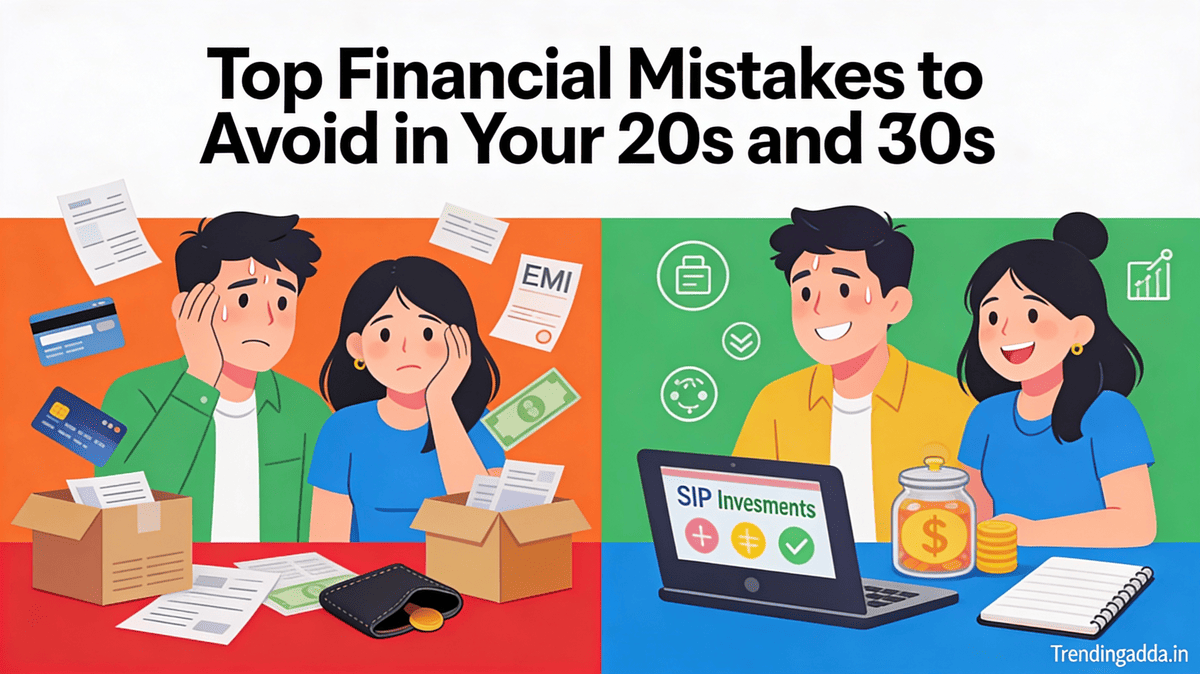

Your 20s and 30s are the most important decades for building financial stability. Decisions made during this phase silently shape your future lifestyle, stress level, and freedom. Unfortunately, many people enter their 40s and 50s carrying regret—not because they earned less, but because they made avoidable financial mistakes early on.
This in-depth guide explains the top financial mistakes to avoid in your 20s and 30s, with Indian real-life examples, practical explanations, psychology behind mistakes, and clear solutions. The goal is simple: help you avoid regret and build long-term financial security.
Why Financial Mistakes in Your 20s and 30s Are So Costly
A mistake at 25 hurts more than the same mistake at 45.
Why?
- You have fewer savings as a cushion
- You have limited experience handling money
- Compounding works against you instead of for you
Money mistakes grow quietly, just like money investments.
A wrong habit repeated for 10–15 years can cost you lakhs—or even crores—over a lifetime.
Mistake 1: Not Saving Money at All
Many young earners believe saving can wait. Salary feels small, expenses feel large, and saving feels optional.
Real-Life Example
Rohit (Age 26) earned ₹22,000 per month. He enjoyed eating out, online shopping, and weekend trips. Saving never felt urgent—until a sudden medical emergency forced him to borrow from friends and use credit cards.
No savings today means no control tomorrow.
Solution
Start small. Even ₹500–₹1,000 per month builds discipline. The habit matters more than the amount.
Mistake 2: Delaying Investments
Many people say:
“I will invest once my salary increases.”
This delay is extremely expensive.
Example
Neha (Age 24) delayed investing for 5 years. Her colleague Pooja started a ₹2,000 SIP at the same age. After 15 years, Pooja’s investment was nearly double—even though the monthly amount was small.
Time beats timing in investing.
Fix
Start early, even with small SIPs. Compounding needs time, not large amounts.
Mistake 3: Living Paycheck to Paycheck
Spending your entire salary every month leaves no breathing room.
Example
Aman (Age 29) earned ₹45,000 per month but upgraded lifestyle with every increment—new phone, OTT subscriptions, frequent dining.
Result: Zero savings despite a decent income.
A high salary without savings is just an illusion of comfort.
Mistake 4: Excessive Credit Card Usage
Credit cards provide convenience—but also temptation.
Example
Sonal (Age 27) used credit cards for shopping and travel. Paying only the minimum due became a habit. Interest piled up quickly.
If you can’t pay the full bill, you can’t afford the purchase.
Solution
Use credit cards only for convenience, never for lifestyle upgrades.
Mistake 5: Falling into the EMI Lifestyle Trap
Phones, gadgets, and even clothes are now sold on EMIs.
Example
Ravi (Age 31) had EMIs for phone, TV, and bike. A single job delay caused panic.
EMIs are easy to start but hard to escape.
Mistake 6: Not Building an Emergency Fund
Without an emergency fund, every problem becomes a crisis.
Ideal Emergency Fund
- Minimum: 3 months of expenses
- Ideal: 6 months
An emergency fund is financial oxygen—you realize its value only when it’s missing.
Mistake 7: Ignoring Health Insurance
Medical emergencies can wipe out years of savings.
Example
Mehul (Age 34) had no health insurance. A hospitalization forced him to use savings and loans.
Health insurance protects your savings, not your health.
Mistake 8: Delaying Retirement Planning
Retirement feels far away in your 20s—but delay is costly.
Example
Starting at 25 vs 35 can create a difference of lakhs.
Retirement planning is cheapest when you are young.
Mistake 9: Not Tracking Expenses
Many people don’t know where their money goes.
You can’t manage what you don’t measure.
Track expenses for 30 days—it changes behavior automatically.

Mistake 10: Blindly Following Friends or Social Media
Financial advice without context is dangerous.
Example
Karan (Age 28) invested in trending stocks because friends did. Losses followed.
What works for others may not work for you.
Mistake 11: Comparing Lifestyle with Others
Comparison leads to overspending and stress.
Comparison is the fastest way to kill savings.
Mistake 12: Not Investing in Skill Development
Saving has limits. Income growth doesn’t.
The best investment in your 20s is in yourself.
Mistake 13: Poor Tax Planning
Ignoring tax-saving options reduces take-home income.
Understand basic tax deductions and exemptions early.
Mistake 14: No Clear Financial Goals
Money without goals disappears quickly.
Examples of Goals
- Emergency fund
- Home purchase
- Child education
Goals give direction to money.
Mistake 15: Avoiding Financial Education
Not learning about money is itself a costly mistake.
Financial literacy is no longer optional.
How to Fix Past Financial Mistakes
If you’ve made mistakes, don’t panic.
Recovery Plan
- Start budgeting
- Clear high-interest debt
- Build emergency fund
- Begin SIPs
The best time to fix mistakes was yesterday. The next best time is today.
Smart Financial Habits to Build in Your 20s and 30s
- Save before spending
- Track expenses monthly
- Avoid unnecessary EMIs
- Invest consistently
- Review goals annually
Psychology Behind Money Mistakes
Money decisions are emotional, not logical.
Fear, greed, and comparison drive most mistakes.
Mastering money starts with mastering behavior.
What are the most common financial mistakes in your 20s?
The most common mistakes include not saving money, delaying investments, overspending on lifestyle, excessive credit card usage, and ignoring health insurance.
Why is it important to avoid financial mistakes early in life?
Mistakes made in your 20s and 30s have more time to compound negatively. Avoiding them early helps build long-term wealth, stability, and financial confidence.
Is it okay to start saving and investing with a low salary?
Yes. Even small savings and investments like ₹500 SIPs help build discipline and take advantage of compounding over time.
What is the biggest financial mistake people make in their 30s?
Not planning for retirement and relying too much on EMIs and loans are the biggest mistakes people make in their 30s.
How much money should I save in my 20s and 30s?
Ideally, save at least 10–20% of your income. If that feels difficult, start with a fixed amount and increase gradually.
Are credit cards bad for young adults?
Credit cards are not bad if used responsibly. However, using them for lifestyle spending and paying only the minimum due can lead to high-interest debt.
Should I buy a car or phone on EMI in my 20s?
Avoid unnecessary lifestyle EMIs. EMIs reduce monthly cash flow and increase financial stress, especially in the early earning years.
What financial habits should I build in my 20s and 30s?
Key habits include budgeting, saving before spending, tracking expenses, building an emergency fund, and investing consistently.
How can I recover if I’ve already made financial mistakes?
Start by tracking expenses, clearing high-interest debt, building an emergency fund, and creating a realistic financial plan.
Is financial education really important at a young age?
Yes. Financial education helps you make informed decisions, avoid costly mistakes, and build wealth faster over time.
Disclaimer:
The information provided in this article is for educational and informational purposes only. It should not be considered as financial, investment, legal, or professional advice. The author and TrendingAdda.in are not SEBI-registered financial advisors.
Before making any financial decisions, readers are advised to do their own research and consult a qualified financial advisor if required. Financial decisions involve risk, and TrendingAdda.in will not be responsible for any loss or damage arising from the use of this information.