
Introduction
Why Interest Rate Comparison Is More Important Than Ever
Personal Loan Interest have become one of the most commonly used financial products in India. From medical emergencies and wedding expenses to credit card consolidation and business needs — unsecured loans are everywhere.
But here is something most borrowers realize too late:
A difference of just 2–3% in interest rate can cost you tens of thousands of rupees over the loan tenure.
And when you compare banks and NBFCs, the difference can be even wider.
Banks usually advertise lower starting rates. NBFCs promise faster approval. Digital apps promise instant money.
So what should you choose?
This guide will help you understand:
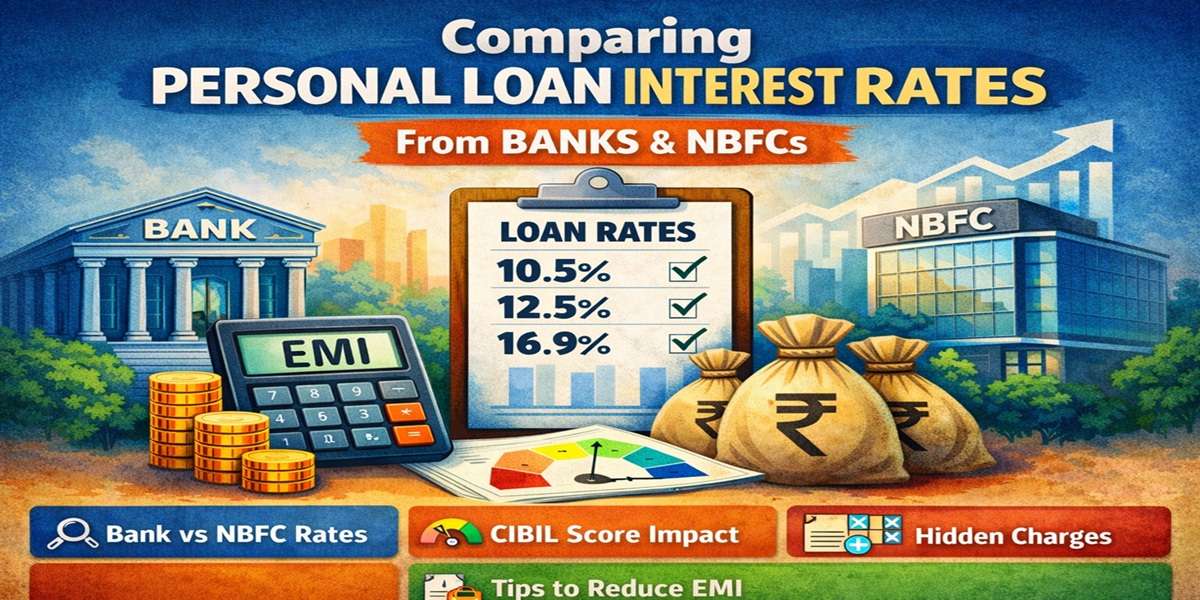
- Current real interest rate ranges in India
- Why banks and NBFCs price loans differently
- How your CIBIL score affects your rate
- Hidden costs beyond interest
- Real EMI comparison examples
- When to choose bank vs NBFC
- How to reduce your interest burden
Current Personal Loan Interest Rates in India
Personal loan rates change depending on RBI policy, repo rate movements, and lender policies.
Based on publicly available information from lender websites and financial marketplaces in 2026, here are the general ranges:
Major Banks – Interest Rate Range
Most large public and private banks currently advertise:
- Starting rate: Around 9.90% – 10.50% p.a.
- Typical approved range: 10.50% – 16.00% p.a.
- High-risk profiles: Up to 20–24% in some cases
Examples of banks offering personal loans:
- State Bank of India (SBI)
- HDFC Bank
- ICICI Bank
- Axis Bank
- IDFC FIRST Bank
- Bank of Baroda
- IndusInd Bank
- Federal Bank
Important: The “starting rate” is usually offered only to high-credit borrowers (CIBIL 750+).
NBFCs – Interest Rate Range
NBFCs generally offer:
- Starting rate: Around 11% – 13%
- Common approval range: 13% – 22%
- Higher risk cases: Can go up to 28–30%
Examples of NBFCs offering personal loans:
- Bajaj Finserv
- Tata Capital
- Aditya Birla Capital
- Fullerton India
- Moneyview
- MoneyTap
- Paysense
NBFC rates are typically higher because they take higher risk and offer more flexibility.
Why Do Banks Offer Lower Rates Than NBFCs?
The difference comes down to three main factors.
1. Cost of Funds
Banks raise money through:
- Savings accounts
- Current accounts
- Fixed deposits
These are low-cost funds.
NBFCs raise money through:
- Market borrowing
- Bonds
- Bank loans
Their borrowing cost is higher — so they charge higher interest.
2. Risk Appetite
Banks prefer:
- Salaried employees
- Stable income
- Strong credit history
- Lower debt ratio
NBFCs are willing to lend to:
- Self-employed individuals
- Freelancers
- Lower credit score applicants
- Thin credit file customers
Higher risk = higher interest.
3. Processing Speed
Banks may take 2–5 days for approval.
NBFCs and digital lenders often disburse within 24–48 hours.
Speed comes at a cost.
How Your CIBIL Score Changes Your Interest Rate
Your credit score is one of the biggest deciding factors.
Here is how lenders usually categorize borrowers:
- 750+ → Prime borrower → Lowest interest
- 700–750 → Moderate risk → Medium interest
- 650–700 → Higher risk → Higher interest
- Below 650 → Limited options → Expensive loans
Example:
Two borrowers apply for ₹5 lakh for 3 years.
Borrower A – CIBIL 780 → Offered 11%
Borrower B – CIBIL 680 → Offered 16%
That 5% difference significantly increases total repayment.
Real EMI Comparison Example
Let’s calculate properly.
Loan Amount: ₹5,00,000
Tenure: 3 Years (36 months)
Case 1 – Interest Rate 11%
EMI ≈ ₹16,374
Total Interest Paid ≈ ₹89,464
Total Repayment ≈ ₹5,89,464
Case 2 – Interest Rate 15%
EMI ≈ ₹17,332
Total Interest Paid ≈ ₹1,23,952
Total Repayment ≈ ₹6,23,952
Difference in interest = ₹34,488
Just 4% higher rate costs more than ₹34,000 extra.
Now imagine loan tenure of 5 years — the gap becomes even wider.
Processing Fees and Hidden Charges
Interest rate is not the only cost.
You must compare:
- Processing fee (1%–3%)
- GST on processing fee
- Prepayment charges
- Foreclosure charges
- Late payment penalties
- EMI bounce charges
Example:
Loan amount: ₹5 lakh
Processing fee: 2%
Processing cost: ₹10,000 + GST
That is money deducted upfront.
Sometimes a slightly higher interest loan with lower fees may actually be cheaper.
Always calculate total cost.
Bank vs NBFC: When Each Makes Sense
Choose a Bank If:
- You have CIBIL above 750
- Stable salaried job
- No urgent need
- Can provide full documentation
- Want lowest possible rate
Banks usually win on long-term cost.
Choose an NBFC If:
- You need funds urgently
- You are self-employed
- Bank rejected your application
- You have moderate credit profile
- You want flexible documentation
NBFCs win on speed and accessibility.
Real-Life Situation: Medical Emergency
Imagine a borrower needing ₹3 lakh for surgery.
Bank asks for income proof and salary slips. Processing takes 4 days.
NBFC app approves in 24 hours.
Borrower chooses NBFC at 17% interest.
Yes, costlier — but emergency timing matters.
Financial decisions are not always mathematical. Sometimes they are practical.
Real-Life Situation: Salary Delay
Startup employee facing salary delay applies for ₹2 lakh.
Bank rejects due to unstable income.
NBFC approves based on bank statement analysis.
Higher rate — but access to funds saves credit card default.
Impact of Tenure on Total Interest
Loan: ₹5 lakh
Rate: 13%
3-Year Tenure
EMI ≈ ₹16,868
Total Interest ≈ ₹1,07,248
5-Year Tenure
EMI ≈ ₹11,377
Total Interest ≈ ₹1,82,620
Difference in interest: ₹75,000+
Lower EMI looks attractive — but total cost increases significantly.
How to Reduce Your Interest Rate Before Applying
- Improve CIBIL above 750
- Reduce credit card utilization below 30%
- Close small outstanding loans
- Avoid multiple loan applications
- Apply through salary bank
- Negotiate if you have strong profile
FAQs
1️⃣ Which bank has the lowest personal loan interest rate in 2026?
Several major banks like SBI, HDFC Bank, ICICI Bank, and Axis Bank advertise rates starting around 9.90%–10.50%. However, the lowest rate is usually offered only to borrowers with a CIBIL score above 750 and stable income. Your approved rate may vary.
2️⃣ Are NBFC personal loans more expensive than banks?
In most cases, yes. NBFCs typically charge slightly higher interest rates because they take higher lending risk and offer faster approvals. However, for self-employed or moderate CIBIL borrowers, NBFCs may be easier to get approval from.
3️⃣ How much difference does 2% interest make on a personal loan?
A 2% higher interest rate on a ₹5 lakh loan for 3 years can increase total interest by ₹25,000–₹40,000 or more. Small rate differences create large long-term cost impact.
4️⃣ Does applying to multiple lenders reduce my CIBIL score?
Yes. Every loan application triggers a hard enquiry. Multiple hard enquiries within a short time can lower your credit score and result in higher interest offers.
5️⃣ Is a 10% personal loan interest rate realistic?
It is possible, but mostly for high-income salaried borrowers with excellent CIBIL scores (750+). Many applicants receive rates between 11% and 16% depending on profile.
6️⃣ Can I negotiate my personal loan interest rate?
Yes, sometimes. If you have:
- Strong credit score
- Stable salary
- Existing relationship with the bank
You may request a lower rate before final approval.
7️⃣ Is it better to take a longer tenure for lower EMI?
Lower EMI feels comfortable, but longer tenure significantly increases total interest paid. Always compare total repayment amount, not just EMI.
8️⃣ Which is safer — bank loan or NBFC loan?
Both are safe if the lender is RBI-registered. However, always avoid unknown loan apps and verify lender credibility before applying.
Disclaimer
The information provided in this article is for educational and informational purposes only. Interest rates, loan terms, eligibility criteria, and charges mentioned are based on publicly available data and may change without prior notice. Actual loan offers depend on individual credit profile, income stability, lender policies, and market conditions.
TrendingAdda.in does not provide financial, legal, or investment advice and is not affiliated with any bank or NBFC mentioned in this article. Readers are strongly advised to verify the latest interest rates, processing fees, and terms directly from the respective lender’s official website before applying.
Taking a loan involves financial risk. Please assess your repayment capacity carefully and consult a qualified financial advisor if needed.




 porntude says:
  333985 says:
  humanlove.stream says:
  www.p2sky.com says:
  porntude says:
  justbookmark.win says:
  https://www.rosewood.edu.na/ says:
  lovewiki.faith says:
  www.89u89.com says:
  https://skitterphoto.com/photographers/1789329/slattery-cooley says:
  https://finley-solomon-3.technetbloggers.de/ says:
  freebookmarkstore.win says:
  https://trade-britanica.trade/wiki/Humatrope_Fr_Pen_6_Mg_12_Mg_24_Mg_Pulver_Und_Lsungsmittel_Zur_Herstellung_Einer_Injektionslsung says:
  graph.org says:
  profeelo.com says: