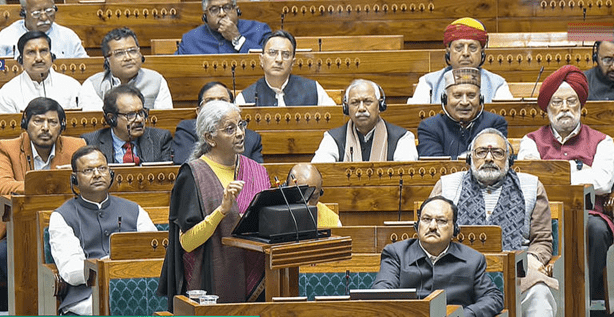

Finance Minister Nirmala Sitharaman on Sunday presented her ninth consecutive Union Budget, outlining the government’s strategy to steer India through global uncertainty while sustaining domestic growth.
The Budget 2026 is built around three core pillars:
- Faster economic growth
- Inclusive development
- Continued structural reforms
The government’s broader sankalp (resolve), Sitharaman said, remains focused on the poor, underprivileged, and disadvantaged sections of society, even as India balances expansion with fiscal stability.
While the Budget brings relief through duty cuts and tax rationalisation across several sectors, individual income taxpayers were left disappointed, with no major changes in tax rebates or standard deductions.
So, what actually becomes cheaper and what turns costlier after Budget 2026? Here’s a clear breakdown.
What Gets Cheaper After Budget 2026
The government has reduced customs duties, excise levies, and tax collection at source (TCS) on multiple goods and services to ease costs for consumers and businesses.
Travel, Education & Remittances
- Overseas tour packages: TCS reduced from 5–20% to 2%
- Overseas education & medical remittances (LRS): TCS cut from 5% to 2%
- Tendu leaves, liquor scrap & certain minerals: TCS reduced from 5% to 2%
Manufacturing, Energy & Infrastructure
- Shoe upper exports: Duty-free import benefit
- Energy transition equipment & solar glass inputs: Basic Customs Duty (BCD) exempt
- Capital goods for critical minerals & lithium-ion cells: BCD exempt
- Civilian aircraft MRO components: BCD exempt
- Fish caught by Indian fishermen & nuclear power goods: BCD exempt
Consumer Goods & Healthcare
- Microwave ovens (personal imports): BCD reduced from 20% to 10%
- Rare disease & cancer medicines: Fully exempt from customs duty
- Bio-gas blended CNG: Excise duty exemption included in calculation
Textiles, Leather & Exports
- Textile & leather exporters: Export realisation period extended to 1 year
- Wet blue leather: Zero import duty
Agriculture & Food Items
- Makhana & roasted nuts: Duty slashed from 150% to 30%
- Almonds & walnuts: Customs duty reduced
- Seeds & spores for sowing: BCD cut from 30% to 15%
Minerals & Industrial Inputs
- Lower or nil duty on:
- Graphite
- Quartz
- Coal
- Sand
- Silicon
- Rare-earth metals
- Metal oxides
- Phosphoric acid: BCD reduced from 7.5% to 5%
- Solar glass chemical (sodium antimonate): Duty reduced to nil
- Petroleum crude: Duty shifted from 5% ad valorem to Re 1 per tonne
Tax Relief Measures
- Certain unexplained income penalties: Tax rate reduced from 60% to 30%
What Gets Costlier After Budget 2026
Not everything is getting cheaper. Some taxes and duties have been raised to curb speculation, discourage harmful consumption, or protect domestic industries.
Tax & Financial Markets
- Income tax misreporting:
- 100% penalty of the tax amount
- Plus tax and interest
- Stock options (STT): Increased to 0.15%
- Futures trading (STT): Raised from 0.02% to 0.05%
Alcohol, Scrap & Minerals
- Alcoholic liquor, minerals & scrap sales:
- TCS increased from 1% to 2%



Imports & Consumer Goods
- Umbrellas & umbrella parts: Floor import price introduced
- Cranberries: Duty increased to 5%
- Blueberries: Duty increased to 10%
- Cranberry products: Duty raised to 10%
- Potassium hydroxide: Duty increased from nil to 7.5%
- Refrigerated containers: Duty increased to 5%
Sin Goods
- Chewing tobacco, jarda & gutkha:
- National Calamity Contingent Duty (NCCD) hiked from 25% to 60%
Coffee Industry
- Coffee roasting, brewing & vending machines used in manufacturing or processing of coffee become costlier due to higher duties.
Budget 2026: The Big Picture
Budget 2026 clearly signals the government’s intent to:
- Support manufacturing and exports
- Strengthen energy security and critical supply chains
- Encourage long-term investments
- Curb speculative trading and harmful consumption
However, the lack of direct income tax relief may leave middle-class taxpayers disappointed, even as businesses and exporters benefit from cost reductions.
Final Takeaway
Budget 2026 is less about headline giveaways and more about structural support and resilience. While some everyday items may get cheaper, higher taxes on trading, imports, and sin goods underline the government’s focus on discipline, stability, and sustainable growth.
Disclaimer
This article is for informational purposes only. Tax and duty changes are subject to official notifications and implementation rules. Readers are advised to consult official government sources or financial advisors before making financial decisions.
Source: Moneycontrol