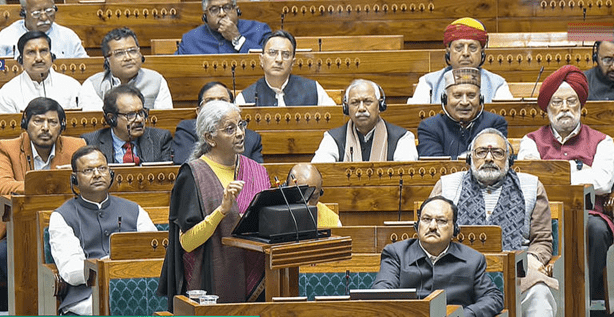

Indian equity markets reacted sharply to the Union Budget 2026 presented by Finance Minister Nirmala Sitharaman on February 1. Contrary to expectations of market-friendly announcements, benchmark indices witnessed a steep sell-off, even as selective sectors saw buying interest.
The Sensex crashed nearly 1,547 points (1.9%) to close at 80,722.94, while the Nifty 50 plunged over 495 points (2%) to end at 24,825.45. Analysts attribute the volatility to a mix of policy surprises, higher transaction costs, and sector-specific disappointments.
Market Reaction: Why Did Stocks Fall After Budget 2026?
Markets had entered Budget Day with cautious optimism, hoping for relief in trading costs, incentives for capital markets, and measures to attract foreign investors. However, several announcements—particularly the hike in Securities Transaction Tax (STT)—triggered panic selling.
✅ What’s Good in Budget 2026 for Stock Markets
1. Buyback Taxation Reworked – Relief for IT Stocks
One of the major positives was the change in taxation of share buybacks. The government proposed taxing buybacks as capital gains for shareholders, while promoters would pay an additional buyback tax.
According to tax experts, this removes ambiguity created by earlier dividend-based taxation rules and brings clarity for investors.
Market impact:
- IT companies that frequently use buybacks to reward shareholders benefited.
- Wipro and TCS rose around 2%
- Infosys, LTIMindtree, and Persistent Systems also closed higher
This move helped ease investor concerns around buyback-related tax uncertainty.

2. Tourism Stocks Rally on Heritage & Travel Push
The tourism sector emerged as a key beneficiary of Budget 2026.
Key announcements included:
- Development of 15 archaeological and heritage sites, including Sarnath and Hastinapur
- Reduction in TCS on overseas tour packages to 2%, without any amount threshold
Market impact:
- Stocks like Easy Trip and other tourism-related companies surged
- Analysts see long-term demand growth for heritage and cultural tourism
3. Jewellery Stocks Gain as Customs Duty Stays Unchanged
Jewellery stocks reacted positively after the Finance Minister kept customs duty unchanged on gold and silver imports.
This helped:
- Protect margins of jewellery companies
- Remove uncertainty over sudden duty hikes
In addition, EMS (Engineering, Manufacturing & Services) stocks gained after a ₹40,000 crore sector outlay was announced.
4. Medical Tourism, Textiles & Other Sectoral Boosts
Other sectors that gained from Budget announcements included:
- Hospital & healthcare stocks: On plans to develop five medical tourism hubs
- Textile stocks: Following measures to modernise the sector and set up mega textile parks
- Fisheries and semiconductor stocks: Benefited from targeted policy support and incentives
These announcements helped cushion the overall market fall.
❌ What’s Bad in Budget 2026 for Stock Markets
1. STT Hike on Futures & Options Spooks Investors
The biggest negative surprise was the sharp hike in Securities Transaction Tax (STT) on derivatives.
New STT rates:
- Futures STT raised to 0.05% from 0.02%
- Options STT also increased significantly
Cost impact:
- For every ₹1 lakh futures trade, STT rises from ₹12.50 to ₹20
- For a ₹10,000 options contract, STT jumps from ₹6.25 to ₹10
Analysts believe this will:
- Increase trading and hedging costs
- Reduce derivative volumes
- Discourage genuine hedging activity
2. Capital Market Stocks Crash
As a direct result of the STT hike, capital market-related stocks witnessed heavy selling:
- MCX fell nearly 12%
- Angel One and BSE dropped over 8% each
Experts suggest the government’s intent is volume moderation rather than revenue maximisation, even if it hurts market sentiment in the short term.
3. Banking Stocks Under Pressure
Banking stocks, especially PSU banks, declined sharply, dragging the Nifty Bank index lower.
Key concern:
- Formation of a high-level committee to review the banking sector
- Fears that the panel may explore mergers among public sector banks
Historically, bank mergers create near-term uncertainty, impacting stock performance.
4. No Big Incentives for Foreign Investors
Another major disappointment was the absence of strong measures to attract foreign investors.
Key concern:
- Foreign investors have already pulled out $23 billion from Indian equities since early 2025
- Higher trading costs and lack of incentives could further deter global capital inflows
Market experts warned that raising frictional costs sends a negative signal at a time when India needs deeper market liquidity.
5. Defence Stocks Fall on Capex Disappointment
Defence stocks also declined after the Budget failed to meet market expectations.
Key numbers:
- FY27 defence expenditure set at ₹5.94 lakh crore, up from ₹5.68 lakh crore
- Defence capital expenditure rose 21% YoY
- Defence modernisation allocation increased 24%
Despite the rise, analysts expected a stronger push, leading to disappointment in defence stocks.
Overall Verdict: Mixed Budget, Negative Market Reaction
Union Budget 2026 delivered targeted sectoral positives, but broader market sentiment was hurt by:
- Higher STT on derivatives
- Lack of foreign investor incentives
- Uncertainty in banking reforms
- Lower-than-expected defence capex enthusiasm
While long-term investors may find opportunities in tourism, IT, healthcare, and textiles, short-term traders faced sharp volatility.
Conclusion
Budget 2026 underscores the government’s intent to curb speculation, strengthen select sectors, and maintain fiscal discipline, even if it comes at the cost of near-term market discomfort. For investors, the key will be to focus on fundamentally strong sectors aligned with policy support, while navigating short-term volatility with caution.
Disclaimer
This article contains information sourced from Moneycontrol, and has been rewritten and adapted for informational and educational purposes. TrendingAdda.in does not claim ownership of the original content. While we strive for accuracy, readers are advised to refer to the original source on Moneycontrol for detailed and official information. TrendingAdda.in is not responsible for any decisions made based on this content.