
2025 already changed the way people invest.
Markets saw ups and downs, inflation played games, and investors started asking a simple but powerful question
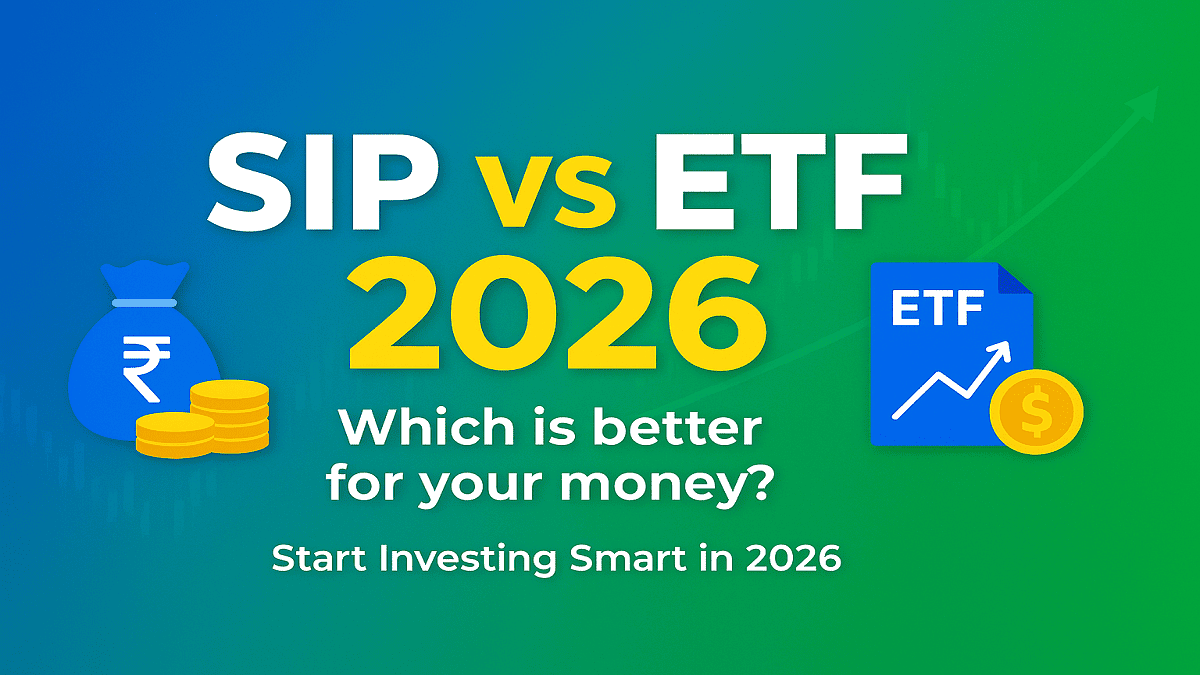
2026 is going to be a major year for investors. Markets are unpredictable, global policies are shifting, and India’s retail investor base is growing faster than ever. Because of this, people are constantly asking:
“Should I put my money in SIP vs ETF in 2026?”
The truth? Both are powerful.
But they work differently, serve different goals, and suit different types of investors.
2026 Is a Turning Point — Should You Put Your Money Into SIP or ETFs?
2026 won’t be a normal year for investments. Here’s why:
✔ Global markets are more connected than ever
One policy change in the U.S. or China affects Indian stocks instantly.
✔ Volatility will be high
Which means SIP investors benefit from averaging; ETF investors benefit from timing opportunities.
✔ Index investing is exploding worldwide
ETFs are getting massive attention.
✔ Digital platforms make ETF buying easier
Demat accounts are increasing every month.
Because of these changes, choosing between SIP and ETF is not just about returns — it’s about strategy.
SIP Explained in the Most Simple Way (No Jargon, Just Reality)
Most blogs complicate SIP.
Let’s make it simple:
SIP = Every month, you invest a fixed amount into a mutual fund.
That’s it.
But the hidden power of SIP is not money — it’s discipline.
⭐ Why SIP Works So Well in 2026
1. Volatility becomes your friend
When markets fall → you buy more units.
When markets rise → you buy fewer units.
This creates the perfect long-term average.
2. You don’t need to study markets
Fund managers do all the hard work for you.
3. SIP avoids emotional mistakes
Human minds panic during crashes. SIP saves you from yourself.
4. Perfect for monthly earners
Salary comes → SIP goes → wealth grows.
5. Best for long-term compounding
2026–2036 could be a golden decade for equity investors.
ETFs Are Exploding in 2026 — But Are They Right for You?
ETF stands for Exchange-Traded Fund.
Think of it as:
- A basket of stocks
- That you buy like a share
- At a very low cost
- With full transparency
⭐ Why ETFs are booming in 2026
1. Lowest charges
Mutual funds charge 1–2%.
ETFs charge 0.03–0.10%.
This difference becomes HUGE in 10 years.
2. You control everything
Buy anytime. Sell anytime. No lock-in.
3. Perfect for index investing
Nifty, Sensex, Nasdaq, Gold — everything is available.
4. Full transparency
You always know what you own.
5. Great for international exposure
Want to invest in U.S. tech?
Just buy a Nasdaq ETF.
SIP vs ETF in 2026 — The Comparison
| Feature | SIP | ETF |
|---|---|---|
| Cost | Higher | Very low |
| Difficulty Level | Beginner-friendly | Needs understanding |
| Control | Low (automatic) | High |
| Market Timing | Not required | Optional but helpful |
| Transparency | Medium | High |
| Volatility Handling | Strong (averaging) | Weak unless chosen well |
| Returns | Stable | Potentially higher |
| Liquidity | Moderate | High |
| Feature | SIP (Systematic Investment Plan) | ETF (Exchange-Traded Fund) |
|---|---|---|
| Definition | Fixed amount invested regularly in a mutual fund | A basket of stocks traded on the stock exchange like a share |
| Cost / Fees | Moderate (1–2% on average, depends on fund) | Very low (0.03–0.10% expense ratio typical) |
| Management | Professionally managed by fund managers | Mostly passive; tracks an index or sector |
| Control | Low — automatic investment | High — you decide when to buy/sell |
| Market Timing | Not required; rupee-cost averaging works automatically | Optional but can impact returns; more active approach possible |
| Transparency | Medium — fund manager decides holdings | High — you see exactly what you own |
| Liquidity | Moderate — redemption takes 1–3 days | High — traded in real time like stocks |
| Risk | Moderate — managed by fund manager | Depends on underlying index or sector; can be higher |
| Best For | Beginners, disciplined investors, long-term wealth builders | Experienced investors, cost-conscious, those who track markets |
| Flexibility | Low — fixed monthly investment | High — buy/sell anytime, invest in multiple ETFs simultaneously |
| Returns | Stable, professional management may outperform markets | Potentially higher due to low cost, passive management, market-tracking |
Key Differences Explained in Simple Words
- Discipline vs Control:
- SIP automatically invests your money every month — great for beginners.
- ETF gives you control over timing, quantity, and selection — better for active investors.
- Cost Difference:
- SIP charges fund management fees (higher).
- ETFs are extremely low cost, which compounds into better long-term returns.
- Market Exposure:
- SIP can be diversified across sectors and asset classes automatically.
- ETF usually tracks an index or sector — need multiple ETFs for proper diversification.
- Volatility Handling:
- SIP averages out market fluctuations over time (rupee-cost averaging).
- ETFs are impacted immediately by market swings; investor must manage timing.
- Ease of Use:
- SIP is “set and forget.”
- ETFs require monitoring, research, and sometimes brokerage accounts.
- Time Horizon:
- SIP works best for 5+ years (long-term).
- ETFs can be used short-term or long-term, depending on strategy.
Warning: Don’t Invest in 2026 Before Reading This Section
This is where most people make BIG mistakes.
❌ Mistake #1: Choosing ETF without understanding how it works
ETF needs basic stock market knowledge.
❌ Mistake #2: Assuming SIP is always slow
Some SIP funds outperform markets brilliantly.
❌ Mistake #3: Switching between SIP and ETF frequently
Frequent switching destroys long-term returns.
❌ Mistake #4: Comparing SIP fund manager’s performance with index ETF
Both follow different strategies.
❌ Mistake #5: Thinking ETFs are only for experts
Some ETFs (like Nifty 50 ETF) are the simplest beginner tools.
Which One Actually Gives Better Long-Term Returns—SIP or ETF?
Honest answer:
✔ ETFs can give higher returns
Because:
- Low cost
- Index-based
- No manager fee
✔ SIPs can outperform markets
When:
- The fund manager chooses high-performing stocks
- Market cycles work in your favor
✔ Best returns come from balance
SIP builds consistency.
ETF reduces cost.
Together → stronger portfolio.
Beginners vs Experienced Investors — Who Should Choose What in 2026?
⭐ If You Are a Beginner:
Choose SIP
Because:
- Simple
- Safe
- Stress-free
- No knowledge needed
⭐ If You Are Intermediate:
Choose SIP + ETF (Nifty ETF)
Because:
- Stability + low cost
⭐ If You Are Experienced:
Choose More ETFs + Sector ETFs + International ETFs
⭐ If You Are a Long-Term Wealth Builder:
Choose SIP as core + ETFs as satellite
The Smartest 2026 Portfolio Strategy
This is the “Core–Satellite Strategy”.
⭐ Core (60–80%): SIP
- Flexi-cap
- Large-cap
- Hybrid
- Blue-chip
⭐ Satellite (20–40%): ETFs
- Nifty ETF
- Nasdaq ETF
- Gold ETF
- Banking ETF
✔ Why this works in 2026
- Balanced volatility
- Lower cost
- International exposure
- High long-term growth
- Emotional stability
- Easy to manage
This strategy is used by:
- Top advisors
- Global investors
- Portfolio managers
Common Investment Mistakes People Will Make in 2026!
🚫 Investing only because others are investing
Choose what fits YOU.
🚫 Ignoring risk and time horizon
SIP = long-term
ETF = medium-long term
🚫 Stopping SIP during market crash
This reduces long-term wealth severely.
🚫 Buying fancy ETFs without research
Some ETFs are hype-based.
1. Basic Requirements for Both SIP and ETF
For SIP:
- PAN Card — Mandatory for KYC verification.
- Bank Account — Linked for auto-debit.
- KYC Completion — Can be done online (Aadhaar + PAN linked).
- Demat Account — Not required for most mutual fund SIPs.
- Initial Investment — Usually ₹500–₹1,000 per month for most funds.
For ETF:
- PAN Card
- Bank Account
- Demat Account — Mandatory, because ETFs trade like stocks.
- Trading Account — Usually with the same provider as Demat.
- Brokerage Account / Platform Fees — Usually low.
2. Platforms to Invest in SIP (India)
| Platform | Type | Features | Best For |
|---|---|---|---|
| Groww | Mobile + Web | Easy UI, multiple fund options, auto SIP setup | Beginners + Young Investors |
| Zerodha Coin | Web + Mobile | Direct mutual funds, zero commission | Cost-conscious, intermediate investors |
| Paytm Money | Mobile | Easy SIP setup, fund recommendations | Beginners + Mobile users |
| ET Money | Mobile | Auto-invest, tax saving funds, reminders | Busy Professionals |
| FundsIndia | Web + Mobile | Detailed research, fund comparison | Experienced Investors |
✅ Steps to invest in SIP–
- Create account on chosen platform
- Complete KYC (upload PAN, Aadhaar)
- Link bank account
- Select fund (large-cap, mid-cap, hybrid, tax-saving)
- Set monthly SIP amount & date
- Sit back — auto-debit will invest automatically


3. Platforms to Invest in ETFs (India)
| Platform | Type | Features | Best For |
|---|---|---|---|
| Zerodha Kite | Web + Mobile | Direct ETF purchase, low brokerage | DIY traders |
| Upstox | Web + Mobile | Simple interface, ETFs, stocks | Beginners + Traders |
| Groww | Mobile + Web | ETFs + Mutual funds on one platform | Beginners + Mobile users |
| Angel Broking | Web + Mobile | ETFs, stocks, research tools | Advanced Investors |
| ICICI Direct / HDFC Securities | Web + Mobile | Full-service platform, advisory | Conservative investors |
✅ Steps to invest in ETF–
- Open Demat + Trading account with chosen platform
- Fund your account (bank transfer)
- Choose ETF (e.g., Nifty 50, Nasdaq 100, Gold ETF)
- Decide quantity and buy at market/limit price
- Hold or sell anytime based on strategy
4. Tips to Start in 2026
- Start Small — ₹500–₹1,000 for SIP, few thousand for ETF.
- Diversify — Don’t put all in one fund or ETF.
- Combine SIP + ETF — Core (SIP) + Satellite (ETF) approach works best.
- Track Quarterly — Check your portfolio, but don’t panic over daily volatility.
- Tax Benefits — Use ELSS funds in SIP for tax saving. ETFs held >1 year may get LTCG benefits.
5. Recommended Strategy for Beginners in 2026
| Portfolio Component | Amount / % | Example |
|---|---|---|
| SIP (Core) | 60–70% | Large-cap mutual fund SIP |
| ETF (Satellite) | 20–30% | Nifty 50 ETF, Gold ETF |
| Emergency Fund | 10% | Bank or Liquid fund (not invested in market) |
Case Study: SIP vs ETF Investment for 5 Years (2026–2031)
Assumptions Used
| Parameter | SIP | ETF |
|---|---|---|
| Monthly Investment | ₹10,000 | ₹10,000 |
| Investment Horizon | 5 Years (2026–2031) | 5 Years (2026–2031) |
| Expected Annual Return | 12% (Mutual Fund Average) | 10% (Index ETF Average) |
| Compounding | Monthly | Monthly |
| Total Investment | ₹6,00,000 (₹10,000 × 60 months) | ₹6,00,000 |
Note: Returns are assumptions based on historical averages. Actual market performance may vary
SIP Growth Calculation

SIP Growth Calculation

Side-by-Side Comparison (5-Year Scenario)
| Investment | Total Invested | Future Value | Profit |
|---|---|---|---|
| SIP (Mutual Fund) | ₹6,00,000 | ₹8,27,600 | ₹2,27,600 |
| ETF (Index) | ₹6,00,000 | ₹7,82,800 | ₹1,82,800 |
Observation:
- SIP slightly outperforms ETF in this scenario because of higher assumed returns (12% vs 10%)
- ETF gives lower cost and more flexibility
- Combining both can give stable + low-cost growth
4. Hybrid Strategy (SIP 70% + ETF 30%)
- SIP: ₹7,000/month
- ETF: ₹3,000/month
SIP FV: ₹8,27,600 × 0.7 ≈ ₹5,79,300
ETF FV: ₹7,82,800 × 0.3 ≈ ₹2,34,800
Final Verdict — The Safest & Smartest Way to Invest in 2026
If you want the simplest answer:
✔ If you want discipline → Choose SIP
✔ If you want low cost → Choose ETFs
✔ If you want best results → Use BOTH
2026 belongs to smart, balanced, long-term investors.
No shortcuts.
No panic.
No gambling.
Just smart decisions.
Your future wealth will thank you
Disclaimer
The information provided in this article is for educational and informational purposes only. It should not be considered financial, investment, or trading advice. Investing in the stock market, ETFs, and mutual funds involves risk, including the possible loss of principal. Before making any investment decision, please conduct your own research or consult with a certified financial advisor. The author and publisher are not responsible for any financial losses or decisions made based on this content. Market performance can vary, and past returns do not guarantee future results
Q: Can I treat this article as financial advice?
A: No. This article is for educational purposes only. It is meant to help you understand SIPs, ETFs, and investing concepts—not to tell you exactly what to buy or sell.
Q: Will I make guaranteed profits by following this guide?
A: No. Investments in stocks, ETFs, and mutual funds carry risk, including potential loss of principal. Past performance is not indicative of future results.
Q: Should I act on this information without consulting anyone?
A: No. Always consult a certified financial advisor or do your own research before making any investment decisions.
Q: Is the author responsible if I lose money?
A: No. The author and website cannot be held liable for any financial outcomes resulting from decisions based on this content


 Binance Account says:
  注册获取100 USDT says: